 16 minutes ago
Paraguay's Senate unanimously impeached Santiago Peña after the collapse of Ueno Bank. The scandal has frozen savings, fuelled protests and widened a criminal investigation.
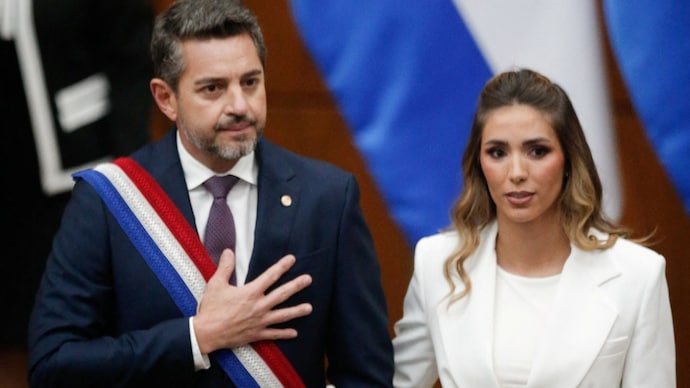
Paraguay's newly sworn-in President Pedro Alliana gestures next to his wife Fabiana Souto after being sworn in as Paraguay's President following Santiago Pena's removal from office in an impeachment trial. (Reuters)
Paraguay's political crisis took a dramatic turn on Friday as the Senate impeached and removed President Santiago Pea over the collapse of Ueno Bank, paving the way for Vice President Pedro Alliana to take over as the country's new leader. Alliana was subsequently sworn in as president, while prosecutors moved to seek arrest warrants against Pea and a former central bank chief amid an expanding criminal investigation into the banking scandal.
All 44 senators present voted in favour of removing Pea on grounds of misconduct in office, bringing an abrupt end to a presidency that had once been regarded as among the most politically stable in South America. The decision came just days after financial regulators seized Ueno Bank, freezing millions of customers' access to their savings and triggering widespread public anger.
The impeachment also prevents Pea from securing a lifetime seat in the Senate, a privilege constitutionally granted to former elected presidents that would have provided him with parliamentary immunity.
Pea had offered to resign on Thursday, but Congress refused to accept his departure, with opposition lawmakers arguing that allowing him to step down would enable him to escape accountability. His lawyers, Ricardo Preda and Adolfo Ferreiro, challenged the decision, maintaining that lawmakers should have approved his resignation instead of proceeding with impeachment.
In a farewell message issued shortly before the Senate vote, Pea said he hoped his departure would prevent further political instability.
"I do not want my presence to be a cause of greater division or instability," he wrote. "My responsibility is to put the country above my personal fate."
The former president has denied wrongdoing. However, prosecutors have launched investigations involving him, Alliana, current and former central bank officials and pension fund authorities. Arrest warrants were also sought against Pea and a former head of the central bank, according to developments reported by the prosecutor's office.
UENO BANK COLLAPSE TRIGGERS POLITICAL EARTHQUAKE
The downfall of Pea's government followed the seizure of Ueno Bank by financial regulators before dawn on Tuesday. The lender, which had rapidly expanded to become Paraguay's fifth-largest bank by deposits, had attracted millions of customers and received hundreds of millions of dollars in public funds.
Lawmakers accused Pea of using his political influence to channel state money into the bank while regulatory authorities turned a blind eye to questionable lending practices and transactions involving companies linked to its owners.
Among the allegations cited in the impeachment proceedings was that the state pension fund deposited approximately $355 million with Ueno, exceeding the legally permitted limits.
Pea also faced scrutiny over his former stake in Ueno's holding company, which he relinquished under pressure last year, and his appointment of a former bank executive to lead the central bank responsible for regulating the lender.
Ueno's rapid expansion had been fuelled by more than $800 million in public money, according to the allegations and figures cited in the proceedings. The bank had built a substantial customer base through aggressive marketing, including supermarket discounts and other incentives, with more than two-thirds of Paraguay's adult population reportedly signing up.
The collapse has raised questions about the independence of the central bank and whether political connections helped the lender escape regulatory scrutiny despite mounting concerns about its financial health.
POLITICAL FALLOUT AND CARTES' ROLE IN PENA'S OUSTER
The crisis also exposed a bitter power struggle within Paraguay's ruling Colorado Party, which had initially backed Pea's rise to the presidency.
Pea, a former Monetary Fund economist and finance minister, owed much of his political ascent to former president Horacio Cartes, the powerful party chief and one of Paraguay's wealthiest businessmen. Cartes had backed him for the presidency despite opposition from rival factions within the party.
However, analysts say Pea gradually built an independent political and business network after taking office, with Ueno Bank emerging as a key part of his efforts to consolidate influence among provincial governors and reduce his dependence on Cartes.
The relationship eventually deteriorated. In September, senators loyal to Cartes sought explanations from the central bank over Ueno's lending practices, citing leaked internal reports that raised concerns about loans to related companies and the lender's financial stability.
Following the bank's collapse, Cartes publicly backed Pea's removal, leaving the president increasingly isolated within his own party.
The political breakdown accelerated on Thursday, when Pea offered to resign as support within the Colorado Party crumbled. By Friday, several senior members of his administration, including the interior minister, chief of staff, legal adviser and political adviser, had also stepped down.
Political analysts described the episode as a dramatic reversal for Pea, whose efforts to establish himself independently of his political mentor ultimately left him without a dependable support base when the crisis erupted.
FROZEN SAVINGS SPARK PROTESTS, NATIONWIDE STRIKE THREAT
The collapse of Ueno Bank has also triggered widespread anger among ordinary Paraguayans, many of whom suddenly found themselves unable to withdraw cash, access their savings or make payments using their bank cards.
The disruption affected millions of customers, including people who had opened their first bank accounts with the digital lender. Even members of Paraguay's national football team, which had been sponsored by Ueno, reportedly found their accounts frozen.
Thousands of depositors have taken to the streets demanding the return of their money and accountability from those responsible for the bank's collapse. Protests this week have turned violent, with demonstrators clashing with police, who used rubber bullets and pepper spray to disperse crowds.
Some customers began receiving their money back on Thursday, with the initial repayments covering deposits of up to 10 million guaranes, or approximately $1,600. Deposits are insured up to around $37,000, a limit that the central bank says covers nearly all Ueno customers.
The central bank has described the collapse as an isolated incident and maintained that the wider financial system remains stable.
However, the repercussions are expected to extend beyond the banking sector. Paraguay's largest teachers' union, representing more than 40,000 members, has announced plans for an indefinite nationwide strike from Monday, demanding safeguards for public pension funds that had money deposited with Ueno.
The controversy has intensified calls for accountability, with opposition lawmakers demanding criminal action against those responsible.
CRIMINAL INVESTIGATION WIDENS AS ASSETS SEIZED
The investigation into Ueno's collapse has expanded beyond the former president and senior government officials.
Prosecutors have charged 27 people, including the bank's controlling shareholder, Miguel Vzquez, with offences including breach of trust and attempted fraud. Six bank directors have been placed in pretrial detention.
Authorities have also seized nine luxury cars from Vzquez's residence, along with a yacht and small aircraft linked to him. Investigators have searched the homes of bank executives in a gated community outside the capital, Asunción.
The investigation is examining the bank's financial dealings, its links with government officials and the handling of public funds deposited with the lender.
With Pea out of office, Alliana sworn in as his successor and criminal proceedings gathering pace, the Ueno collapse has plunged Paraguay into its most serious political crisis in more than a decade.
- Ends
With inputs from PTI, Reuters