1 hour ago
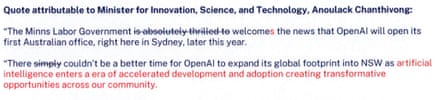
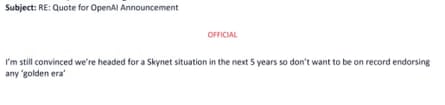
The NSW technology minister’s office removed a reference to being “absolutely thrilled” about OpenAI opening a Sydney office after staffers joked a dystopian Skynet could be headed for the city within five years.
Artificial intelligence giant OpenAI announced its first Australian office in August last year, before opening in December.
In emails tabled in NSW parliament this week, and provided to Guardian Australia, staff members in technology minister Anoulack Chanthivong’s office debated the phrasing of media comments welcoming the announcement.
Sign up for the Australia emailWhat started out as: “The Minns Labor government is absolutely thrilled to welcome the news that OpenAI will open its first Australian office, right here in Sydney, later this year”, subsequently had “absolutely thrilled” removed, leaving just “welcomes the news”.
“Fine – I will roll out ‘golden era’ next time,” the minister’s deputy chief of staff replied after the suggested changes.
“I’m still convinced we’re headed for a Skynet situation in the next 5 years so don’t want to be on record endorsing any ‘golden era’,” another staffer joked.
Skynet is the Terminator film series’ fictional artificial intelligence , which achieves sentience and wipes out billions of people on Judgment Day.
Despite the staff members’ restraint, the documents reveal how fervently members of the NSW government were courting the US tech company before its decision to open a Sydney office.
In a meeting between Chanthivong and OpenAI to encourage the company to invest in NSW in June last year, key messages included that Sydney was the number one startup location in the southern hemisphere, attracting 65% of all venture capital in Australia, and was home of tech companies Atlassian, Canva and Afterpay.
It was also suggested the minister should tell OpenAI that major US tech companies including Google, Microsoft, Meta, AWS and IBM, had Australian headquarters in Sydney.
“NSW is home to Australia’s Al ecosystem,” the talking points stated. “45% of all Al businesses in Australia are in NSW.”
Approached for comment, a spokesperson said the NSW government was committed to embracing AI opportunities “while ensuring emerging technologies are used responsibly and in the public interest”.
The state government is developing a strategy around datacentre development to support the growing AI sector, but has yet to announce when it will be released.
Asked in the NSW inquiry into datacentres on Thursday whether NSW was falling behind Victoria and South Australia, the environment minister, Penny Sharpe, said she was not concerned as Sydney posed a “highly desirable location”.
State and federal governments are also balancing the push for AI investment with growing community concern over datacentres, including their impact on the environment.
Datacentres typically use diesel generators when there are power outages. Documents from a May 2026 meeting revealed NSW environmental protection authority modelling showing that if all eight large datacentres in the Sydney basin ran their generators at the same time, the one-hour air pollution load would be five to six times that of all electricity generation in NSW and five to six times greater than that of all motor vehicles in NSW.
“Cumulative impacts are critical given that, in a power outage, several [datacentres] may turn on [generator] sets,” the document stated.
The chief executive of Data Centres Australia, Belinda Dennett, said this was the worst-case scenario modelled and would be an extremely rare and catastrophic event.
“Backup generators are standby equipment, not power stations. They run mainly for brief, staggered testing, with rare emergency use, and each site’s emissions are already modelled against the EPA’s air quality criteria as a condition of approval,” she said.
NSW Greens MLC, Abigail Boyd, who is chairing the state’s datacentres inquiry, said the documents showed the current air impact assessments on datacentres were not robust as they underestimated hours.
“Datacentre loads are a key source of grid strain and volatility – blackout events are more likely with more datacentres pulling on the grid and transmission capacity,” she said.
Boyd said there could be a situation when datacentre power demand pushed customers off the network, or datacentres disconnected and were forced to use diesel generators.
“It’s a disaster waiting to happen. Particularly given the proximity of many of these projects to dense residential areas and schools.”