 1 hour ago
Macron condemns 'ultra left's ... seditious acts' aiming to 'bring down the Republic'
Macron begins by acknowledging there were some “shortcomings” in response to last weekend’s protests, with “an element of surprise.” He says the government needs to learn from that and apply it to this weekend’s events.
He says that local authorities have been empowered to adopt local measures, such as bans on gatherings, and the judicial system is “fully mobilised” to respond to events.
The president backs the justice ministry’s call for seeking harsh punishments for those involved in the riots.
He then makes it very clear what he makes of the riots:
“We witness both political and even seditious acts carried out by organised ultra-left groups aiming to bring down the Republic - acts that these groups themselves openly claim, characterised by extreme, intense violence.”
Key events
Paris police approves main union-backed demonstration, but bans another one
Meanwhile, the Paris prefecture has approved the proposed route of the main Parisian demonstration on Saturday, from Place de la Bastille to Place de la Nation.
But a separate demonstration organised by the students collective Interfac and the so-called “yellow vests,” which wanted to go from Bastille to Place de l’Opera, will be blocked, the local authorities decided, as quoted by Le Monde.
Strong response from Macron as he seeks to differentiate between legitimate protests and ultra-left riots - snap analysis
Jakub Krupa
It’s a strong political response from Emmanuel Macron as he seeks to draw a clear line between legitimate demonstrations organised by recognised trade unions and the looser, often spontaneous gatherings called by the “ultra-left” that descend into rioting and street violence – and show the state’s determination to fight back against the latter.
The signal he wants to send is very clear – but in the age of social media, can top-down regulation actually work? And will authorities have enough resources on the ground to respond to every banned demonstration?
Hm.
France will seek to ban demonstrations not organised by trade unions, Macron says
Macron declares the government will show “absolute” determination to stop the riots, with a “multi-pronged” approach in response to the events to restore order.
He says that legitimate demonstrations held by trade union groups will be “reviewed in accordance with our laws” and allowed to go ahead in a way ensuring they can go ahead safely, with potential changes to their routes and subject to additional conditions.
But he says any other protests, not organised by trade unions, will “wherever possible” be “prohibited entirely”.
On substance, he says that PM Lecornu will meet with student organisations next week to work on “legitimate requests and grievances”.
He ends by saying that he will hold further meetings with relevant authorities tomorrow.
Macron condemns 'ultra left's ... seditious acts' aiming to 'bring down the Republic'
Macron begins by acknowledging there were some “shortcomings” in response to last weekend’s protests, with “an element of surprise.” He says the government needs to learn from that and apply it to this weekend’s events.
He says that local authorities have been empowered to adopt local measures, such as bans on gatherings, and the judicial system is “fully mobilised” to respond to events.
The president backs the justice ministry’s call for seeking harsh punishments for those involved in the riots.
He then makes it very clear what he makes of the riots:
“We witness both political and even seditious acts carried out by organised ultra-left groups aiming to bring down the Republic - acts that these groups themselves openly claim, characterised by extreme, intense violence.”
Macron briefing press after French security council talks
Jakub Krupa
Finally!
France’s Macron is speaking now after this morning’s security council meeting on protests across the country.
I’m listening and will bring you the key lines here.
criminal court awarded the EU's 2026 Sakharov human rights prize
The international criminal court and its officials have been awarded the prestigious 2026 EU Sakharov human rights prize, the European parliament’s speaker Roberta Metsola just announced.
“The European Union is built on respect for multilateralism and international institutions, and this prize recognises the important work of the court in upholding international law and justice,” Metsola said.
It’s the latest recognition for the ICC as it finds itself under growing pressure from its critics, primarily the US president, Donald Trump, and Israel’s Benjamin Netanyahu.
“I also want to use this moment to recognise Tundu Lissu from Tanzania, and Taraneh and Romina Rahimi on behalf of all those persecuted by the Iranian Islamic Regime,” Metsola added.
The award ceremony will take place in December.
French city of Lyon bans all protests on Saturday fearing repeat of riots, street violence
Officials have banned “all protests” in France’s third-biggest city of Lyon on Saturday, ahead of nationwide demonstrations that day following rallies last weekend that descended into widespread street violence, AFP reported.
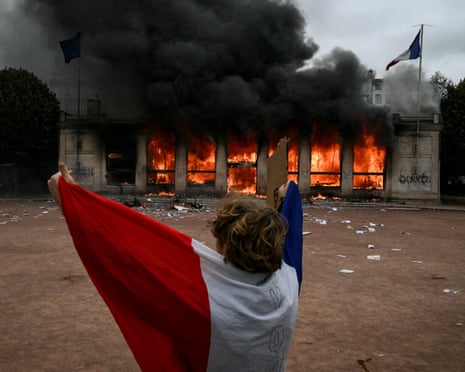
The prefecture for the Rhone region said on Thursday in a statement to media that, “given the events of 17 October, the prefect has decided to ban by decree all protests in the city of Lyon this Saturday, 24 October”.
Lyon, like Paris and other French cities, suffered clashes and looting when masked youths took to city centre streets on the sidelines of mass rallies protesting high inflation.
The mayor of Lyon, Grégory Doucet, has said that his city experienced hours of “chaos” during the riots, with between 150 and 200 shops looted and a tourist office torched. Police arrested some 200 people.
Police presence at this weekend's French protests expected to be '20% higher,' minister says
As we are waiting for Macron, first details of the planned police response to this weekend’s protests are emerging.
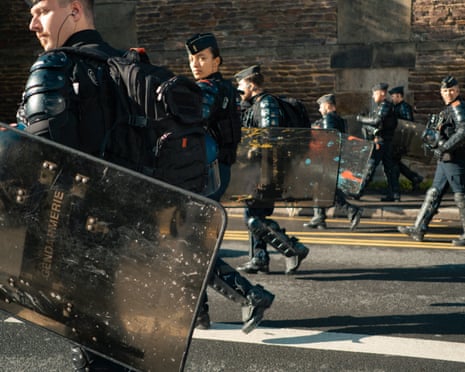
Junior interior minister, Jean-Didier Berger, said that the police presence will be “20% higher” than last weekend, with reinforcements from the army, elite police forces and gendarmerie.
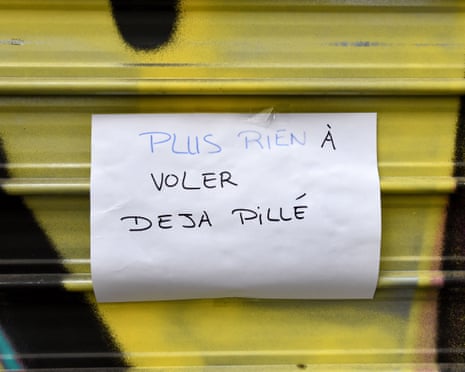
But French media are reporting that some shopkeepers do not seem to be convinced, and they reinforce their own security measures, closing and boarding up some of their shops.
Southern Italy brought to standstill with food, fuel shortages, and business impact
Lorenzo Tondo
in Palermo
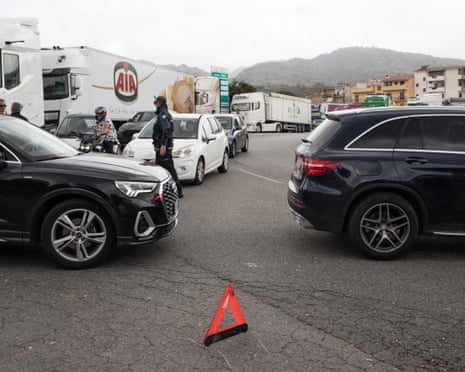
As lorry drivers’ protests bring much of southern Italy to a standstill amid food and fuel shortages, with businesses warning they are on the brink of collapse, Italian authorities have launched a police crackdown on road blockades.
The interior ministry said on Wednesday that 1,339 protesters had been identified, 71 reported to judicial authorities and 242 fined over what it described as “illegal road blockades”. Police escorted hundreds of vehicles carrying goods, including 500 in Campania alone, while the interior minister, Matteo Piantedosi, warned of possible infiltration by criminal groups.
Industry associations in Campania and Puglia warned that businesses were on the brink of collapse, prompting the prime minister, Giorgia Meloni, to convene an emergency cabinet meeting.
“The truckers’ dispute requires an immediate response,” said industry associations representing Naples and other parts of Campania and Puglia in a joint statement. “Production has ground to a halt due to a lack of supplies. The strike must end; otherwise, the damage to consumers and businesses, which is already significant, will become unsustainable.”
The protests began last week, with lorry drivers blocking roads and slowing traffic across the country, particularly in the south, following strikes and sit-ins by farmers and fishers.
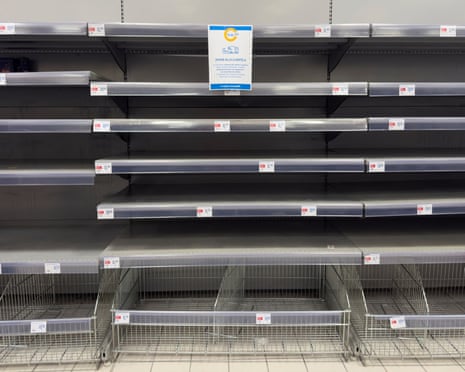
The disruption has left supermarket shelves empty in several regions. Stocks at some supermarket chains have reportedly fallen to 50% of normal levels.
Italy’s air traffic management agency, ENAV, said on Wednesday that Crotone and Reggio Calabria airports had run out of jet fuel because of supply disruptions.
According to estimates gathered by Confcommercio Sicilia, the five-day disruption to freight transport has caused between €40m and €50m in losses in Sicily alone, affecting supermarkets and the wider fresh food supply chain.
The protests threaten to deepen the crisis facing Meloni’s government, which is struggling to contain the unrest. Measures announced so far by Rome appear to have done little to appease lorry drivers, prompting the government to take the controversial step of attempting to quell the protests through a police crackdown.
And as we wait for Macron, we have an update for you from Italy on lorry drivers’ protests there.
Macron set to speak after emergency security council soon
Jakub Krupa
I am keeping an eye on France, where Emmanuel Macron is set to speak shortly after this morning’s emergency security council meeting ahead of more protests expected this weekend.
I will bring you the key lines when he shows up.
Russia, Ukraine exchange fallen soldiers' bodies
Meanwhile, we are getting more lines from Ukraine, with Belarusian state news agency reporting that Russia and Ukraine exchanged bodies of their war dead today.
Moscow handed over 252 corpses, and received 25 bodies in return, it said.
We will no doubt hear about this from the official channels later.
France reports first human Shamonda virus case
Meanwhile, French health authorities said they had detected the Shamonda virus usually affecting livestock in a human for the first time in a patient who later died, while adding that they saw no risk to the general population at this stage.
Shamonda virus is an insect-borne Orthobunyavirus primarily affecting livestock, particularly cattle, and transmitted by biting midges, Reuters explained.
First identified in Nigeria in the mid-1960s, it has since been detected sporadically in animals in Africa and Japan. It has been spreading among several European countries this year.
The virus had until now been considered non-transmissible to humans, the French government said.
Italy, Spain agree to drop post-Ceuta Schengen suspension
Italy and Spain have dropped mutual border controls introduced in the aftermath of the Ceuta border crisis.
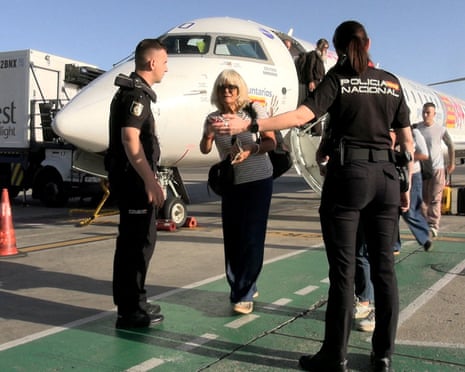
We covered that scenario on the blog last week (Europe Live, Friday).
In a statement, the Italian interior ministry said the two interior minister held “a cordial telephone” and “agreed that the suspensions of Schengen in force … will not be extended further.”
“The decision, which came after a careful analysis of the situation, will be accompanied by a strengthening of the exchange of information to ensure the full security of the Schengen common area,” the statement said.
Zelenskyy appears to take dig at Witkoff for his praise for 'humanitarian' Putin after Kyiv attacks
Oh, that’s tasty.
Ukraine’s president Volodymyr Zelenskyy responded to overnight attacks on Kyiv with a dig at US peace envoy Steve Witkoff’s comments lauding Russia’s Vladimir Putin as “a humanitarian”.
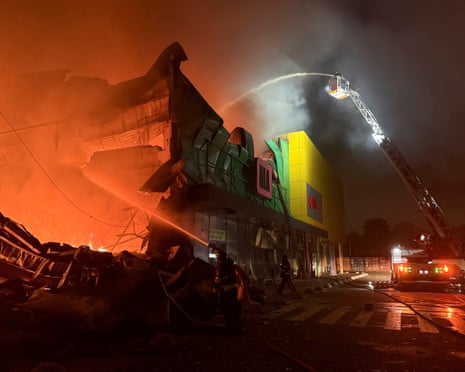
Zelenskyy said:
“Three waves of ballistic missiles have been launched at Kyiv by Russian ‘humanitarians’ since yesterday evening. They used 21 missiles. Unfortunately, numerous sites across the city have been hit and damaged: ordinary residential buildings, energy facilities, infrastructure at one of the railway stations and the metro, shopping malls, and businesses. Even a monastery is among the damaged sites. Our emergency services are working at all the affected locations. Twelve of our regions came under Russian attack overnight.”
He said that at least two people died and 34 people were injured, including five children, in Kyiv.
“Almost immediately after another round of talks, Russia launched a pointed attack. This means there has been no real change in its attitude toward everything that is happening. It is important to keep trying to find the right solutions to end this war. But when Russia responds to negotiations with ballistic missiles, real pressure on Russia is needed to bring about different steps – steps toward ending the killing.”
Thailand, Malaysia urge citizens to avoid protest-hit EU countries
Thailand has advised its citizens to postpone non-essential travel to parts of Europe rocked by protests, while Malaysia also warned its nationals about visiting France, AFP reported.
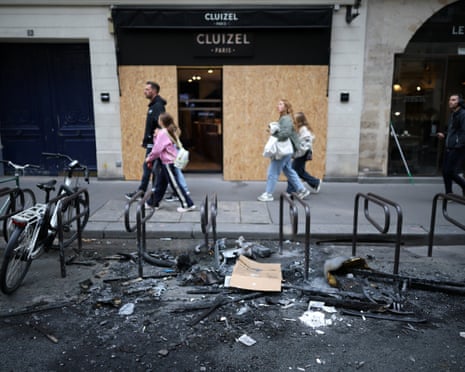
“Those travelling from Thailand to Europe must closely monitor the situation as it is changing rapidly and France remains a concern as the situation is still ongoing,” Thai foreign minister Sihasak Phungketkeow told reporters late Wednesday during a trip to Italy.
He cited concerns about protests in Italy, noting his Italian counterpart had to cancel their bilateral due to an urgent government cabinet meeting on the unrest, adding: “We are also worried about Spain.”
“If it’s not necessary, with everything going on in those countries, I think it’s better to delay the trip for a while.”
The Malaysian embassy in Paris had on Sunday advised Malaysians in France “to exercise caution and remain vigilant” due to the protests.
China warned its citizens travelling to France to take safety precautions, state broadcaster CCTV reported Monday, after town halls and shops were looted and set on fire at the weekend.
Morning opening: Macron hosts a security council meeting on protests
Jakub Krupa
French president Emmanuel Macron is back from his tour of the Gulf and convening a meeting with relevant ministers and intelligence services to figure out what can be done to prevent unsavoury scenes on the streets of French cities as more protests are planned for this Saturday.
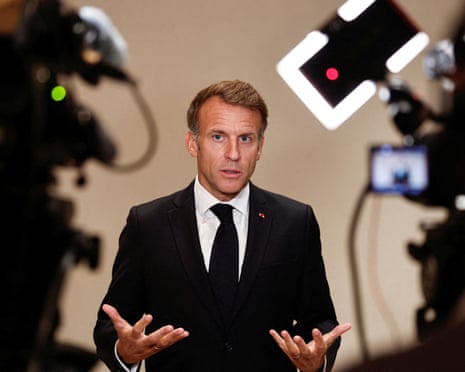
“The government must hold its nerve,” Macron told reporters earlier this week.
He is expected to speak after the meeting, so once to watch.
Later today, French prime minister Sébastien Lecornu will hold a separate meeting with party leaders to discuss their concerns, including about policing and the next year’s presidential campaign.
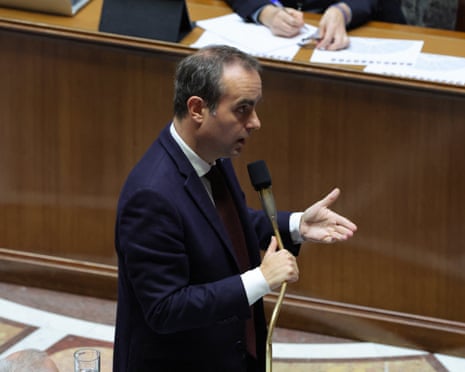
Over in Ukraine, there are no signs of Russian attacks stopping anytime soon, after a night of “massive strikes” on port infrastructure facilities in Odesa region and on Kyiv.
Ukraine’s foreign minister Andii Sybiha commented on the attacks, saying:
“Kyiv residents heard what Russian ‘humanism’ truly sounds like: a brutal attack with dozens of ballistic missiles striking energy infrastructure, medical facilities, shopping centers, and residential areas. Other cities across Ukraine came under attack as well.
Appeasement, servility, and flattery will not stop this war. Only strength will.”
No prizes for guessing who he may be addressing these comments to.
I will also bring you the latest from Serbia where the last day of campaigning begins before this Sunday’s closely contested parliamentary election.
Lots for us to cover.
It’s Thursday, 22 October 2026, it’s Jakub Krupa here, and this is Europe Live.
Good morning.