 1 hour ago
Taken to ISIS-controlled Syria as a teenager by her father and married off to a terrorist, Halima Salman of the US has been convicted of receiving military training from the terror group. The ISIS Bride is the first woman to face trial in the US on charges of joining the Islamic State.
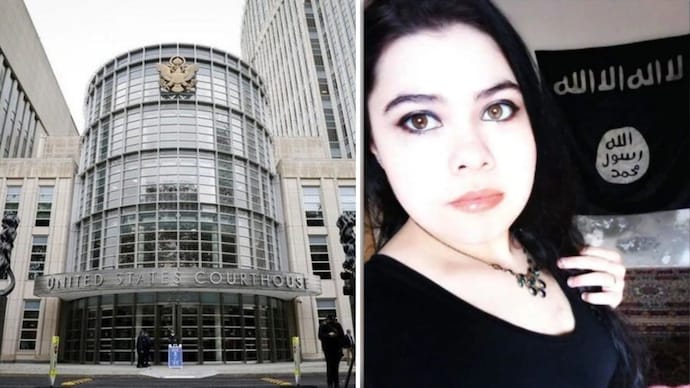
Halima Salman was convicted by the federal jury of New York's Brooklyn, her sentencing take place in February 2027. (Image: Reuters, US Eastern District)
A US woman whose father took her to Islamic State-controlled territory in Syria when she was 17 and got her married to an ISIS fighter has been convicted of receiving military training from the terror group. Halima Salman, popular as the ISIS Bride, is the first American to face trial in the US on charges of joining the Islamic State.
A federal jury in New York's Brooklyn on October 27 found the 27-year-old Halima guilty of knowingly receiving military-type training from the Islamic State (IS), a designated terrorist organisation. The conviction followed a trial in which prosecutors portrayed her as a willing participant in the extremist organisation, while the defence argued that she was a teenager manipulated by her father and subsequently controlled by her husband. Halima's husband, Abu Ali, is reportedly in an Iraqi jail.
Halima's charge carries a maximum prison sentence of 10 years. Her sentencing is scheduled for February 2, 2027. Halima's lawyers have also sought to have the verdict overturned, arguing that the evidence was insufficient to establish that she received military training.
HALIMA SALMA'S JOURNEY FROM BROOKLYN TO ISIS-CONTROLLED SYRIA
Born in Brooklyn in 1999, Halima Salman is the daughter of an American mother, Brandy Salman, and a Turkish father. She was 17 when her father took the family from the United States to Turkey in 2017. What she believed was a trip to visit relatives turned into a journey into Syria, where ISIS controlled large parts of the country.
Halima testified that she did not know where her father was taking the family until their vehicle crossed into Syria and armed men surrounded them. She recalled being frightened and confused as they were ordered to hurry.
"I do blame my father for a lot of things that happened," she told the court.
According to Halima's testimony in court, she spent around three months in accommodation run by ISIS before reuniting with her family. The family subsequently moved between homes as airstrikes hit their neighbourhoods.
After turning 18, Salman was married to an ISIS fighter identified in court documents as Abu Ali, a German-Afghan terrorist. Her father arranged the marriage. The defence portrayed it as forced, while Halima said she had resisted being married off and repeatedly attempted to secure a divorce.
Recalling the first day of her marriage, she told the court that her husband ordered her to get up and perform her duties as a wife.
Much of her married life, she said, involved domestic work for her husband and mother-in-law. She also described strict restrictions on her movements, saying she could not leave the house without her husband's permission.
Her father died in 2018 after being injured in an airstrike.
THE AK-47 VIDEO THAT BECAME KEY EVIDENCE AGAINST HALIMA SALMAN
Prosecutors argued that Halima was not merely a woman living in ISIS territory but someone who willingly sought military training and aligned herself with the organisation.
According to the US Department of Justice, she received training at Nusaybah Katiba, an all-female ISIS military battalion. The prosecution presented a document found on her husband's recovered cellphone that purportedly certified her completion of the training and authorised her to carry an assault rifle and ammunition.
US investigators also recovered photographs showing Halima with an ISIS flag in the background and a video in which she is seen handling an AK-47 while her husband filmed her.
The prosecution also referred to a religious song about Osama bin Laden that Halima had sent her husband. Assistant US Attorney Amanda Shami told the jury that the evidence established that Salman had received military training from a violent terrorist organisation responsible for attacks across the world.
The defence, however, questioned the reliability of the central document. According to Courthouse News Service, Salman's lawyer, Mia Eisner-Grynberg, argued that the purported weapons authorisation was questionable because it lacked the official stamp found on other ISIS documents presented during the trial. The document was also recovered as an image on her husband's phone rather than from ISIS records.
The defence further argued that prosecutors had not produced witnesses who had seen Halima attending a training session or established that the battalion conducted such training in the area where she lived.
Salman maintained that she had only handled the rifle because her husband asked her to. WAS
THREATENED WITH DEATH, SAYS HALIMA SALMAN
The defence sought to establish that Halima was a vulnerable teenager who had been taken into a conflict zone against her will and was trapped in an abusive marriage.
"You try to leave, it is death," she told the court, describing the dangers of attempting to escape from ISIS-controlled territory.
Halima recalled that the final year of her marriage was particularly traumatic. Constant airstrikes forced the family to move repeatedly, sometimes leaving them on the streets. "I saw dead bodies everyday," she said.
Halima and her husband fled with other refugees in a truck. During the journey, she told him that they would separate. She testified that she never saw him again.
In 2019, she was detained in Baghouz, Syria, by forces fighting ISIS as the group's territorial control collapsed. She remained in detention in northeastern Syria for several years before returning to the United States in 2024. US authorities arrested her when she arrived in New York.
THE LARGER QUESTION OF ISIS BRIDES WHO RETURN
Salman's case also brings renewed attention to the question of what should happen to women and children associated with ISIS who remain in detention camps in Syria. Governments have struggled to determine whether women who travelled to join the extremist group should be treated as security threats, victims of coercion or both.
One of the most prominent cases is that of Shamima Begum, who left Britain for Syria in 2015, when she was 15, along with two school friends to join ISIS. She married an ISIS fighter after arriving in Syria and later lost her British citizenship on national security grounds.
In July 2020, Begum won a legal battle allowing her to return to the UK to challenge the decision to strip her of citizenship, with an appeals court ruling that she could not effectively participate in the proceedings from a Syrian detention camp. However, in February 2024, Britain's Supreme Court dismissed her appeal against the citizenship decision, leaving her stateless and in a camp in northeastern Syria.
The Islamic State seized large parts of Iraq and Syria in 2014 and declared a caliphate. Although it lost its territorial strongholds in Iraq in 2017 and Syria in 2019, the organisation continues to operate through sleeper cells and insurgent networks.
In the US case against Halima, prosecutors argued her actions demonstrated a willingness to receive training from ISIS. Her defence insisted that the evidence needed to be viewed against the circumstances of a teenager taken into a war zone and married to a ISIS terrorist.
The jury has delivered its verdict. Now all eyes are on the US court's decision on sentencing in February.
- Ends