 1 month ago
JD Vance said conversations regarding nuclear inspections inside Iran could begin as early as this week. It is being seen as one of the most significant developments since negotiations resumed.
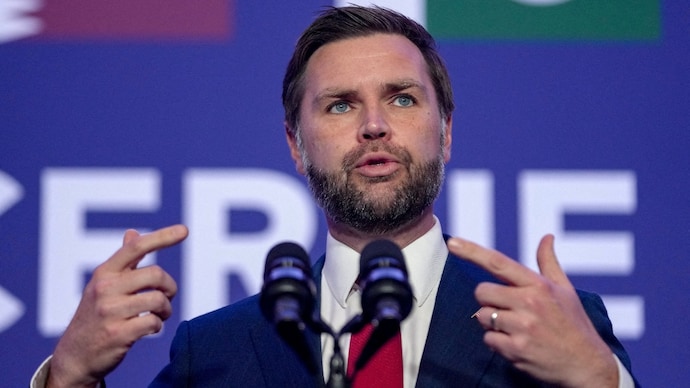
US Vice President JD Vance speaks to members of the media, after the US and Iran held high-level talks at the Lake Lucerne Summit. (Photo: Reuters)
Fresh momentum has emerged in negotiations between the US and Iran after a new round of talks in Switzerland, with US Vice President JD Vance announcing progress on several core issues, including nuclear inspections, Lebanon ceasefire and the possible unfreezing of Iranian assets.
Speaking after concluding hours of high-level discussions on a potential final deal at Burgenstock, Switzerland, Vance said Iran had agreed to admit inspectors from the Atomic Energy Agency (IAEA).
"That is a major milestone for the American people, and the first step in permanently denuclearizing or permanently ending a nuclear weapons program in Iran, and that's exactly what we wanted to do," Vance said.
According to the Vice President, conversations regarding inspections could begin as early as this week. It is being seen as one of the most significant developments since negotiations resumed. Iran had suspended cooperation with the IAEA after the 12-day war with Israel and the US in June 2025 and subsequently blocked inspectors from accessing several key nuclear facilities.
Vance described the talks as a "very, very good day" and said negotiators had succeeded in laying the groundwork for a final deal.
"We laid a very good foundation for a successful final deal, the final deal is the house," Vance said. "We set the foundation, we haven't built the house, but we've laid a successful foundation to get to a good place for the American people."
FROZEN IRANIAN ASSETS COULD FUND US FARMERS
One of the most notable elements discussed during the negotiations involved a proposal for dealing with billions of dollars in frozen Iranian assets. He revealed details of a mechanism that would allow Iran access to some of its funds while giving the US oversight over how the money is spent.
The proposal was conceived by Jared Kushner, President Donald Trump's son-in-law, and developed in coordination with Qatar.
"We wanted to make sure that we set up a process where if we ever unfreeze Iranian assets, we can ensure that money, that Iranian money, goes to help the people of Iran and not to fund terrorism," Vance said.
"Jared Kushner actually came up with a very interesting solution with the Qataris, where basically -- again if there is any frozen Iranian assets that are unfrozen – then we have approval over that process, the Qataris have approval over that process, and then the money would actually go to buy American corn and American wheat for the benefit of the Iranian people," he added.
The proposal appears designed to address criticism from hardline Iran critics, who argue that financial relief could indirectly bolster Tehran's regional influence.
US officials have long maintained that humanitarian spending restrictions can prevent funds from reaching militant groups. Critics, however, have argued that allowing humanitarian purchases could free up other Iranian resources for military or strategic activities.
The framework outlined by Vance resembles a mechanism used during former President Joe Biden's administration. In 2023, Iranian funds held in South Korea were transferred under a prisoner exchange agreement. Those funds could only be used for approved humanitarian purchases, including food, medicine and agricultural goods, with transactions monitored by US authorities.
Vance characterised the new proposal as "a classic Trump deal, where if Iranian assets are ever unfrozen, they're going to go to make American farmers richer and to feed the Iranian people."
Another major topic during the talks was the Strait of Hormuz, one of the world's most important shipping routes.
"First, we wanted to build a mechanism for keeping the Strait of Hormuz open — it is open," he said.
As shipping activity gradually resumes, participating countries are working on coordination efforts involving de-mining operations and trade restoration measures.
CEASEFIRE EFFORTS IN LEBANON
Negotiators also focused heavily on preventing regional conflict, particularly in Lebanon, where fighting between Israel and Hezbollah has complicated diplomatic efforts.
According to Vance, a separate mechanism was being developed to manage ceasefire arrangements and avoid future escalation.
Talks aimed at ending hostilities in southern Lebanon remain ongoing, and the vice president described them as a "work in progress."
"The previous 24 hours were pretty good," Vance said. "Obviously, there was some shooting about 72 hours ago, so this is a work in progress, but what we've done is actually set up the operation so that we can ensure it doesn't spiral out of control in the future."
Fighting between Israel and Hezbollah had already complicated negotiations, and tensions escalated further when Iran briefly walked out of the Switzerland talks after President Donald Trump threatened fresh military action if Tehran failed to rein in its proxies, including Hezbollah in Lebanon.
According to mediators Qatar and Pakistan, the US and Iran agreed overnight to establish a "de-confliction cell" involving Lebanon. The mechanism will be facilitated by Qatar and Pakistan and is intended to support the cessation of military operations in the area.
VANCE SAYS TRUMP'S REMARKS DID NOT DERAIL TALKS
Vance also pushed back against claims that Trump's remarks on Lebanon disrupted negotiations. Asked whether those comments complicated the diplomatic process, Vance dismissed the idea.
"No, they didn't throw a wrench in the system," he said.
"There was a little bit of threatening, there was a little bit of whining, but at the end of the day, the talks continued, and we made great progress."
He added that US officials had informed Iranian negotiators that Trump would continue responding forcefully to public statements from Tehran.
"What we told the Iranians yesterday is when you guys engage in what us millennials might call trash talk, you can't expect the president of the United States not to respond and not to correct the record," Vance said.
While Vance is returning to the United States, negotiations are far from over. The Vice President said technical teams would remain engaged in the coming weeks to work through details and transform preliminary agreements into a final deal.
"As much as this place is very beautiful, I can't stay here for the next 60 days," Vance said.
- Ends
With inputs from agencies
Published By:
Satyam Singh
Published On:
Jun 22, 2026 18:32 IST