1 month ago
Trump-backed conservative Nasry Asfura won Honduras' presidency after a weeks-long count, defeating rival Salvador Nasralla in a disputed election that exposed strains on the country's fragile electoral system.
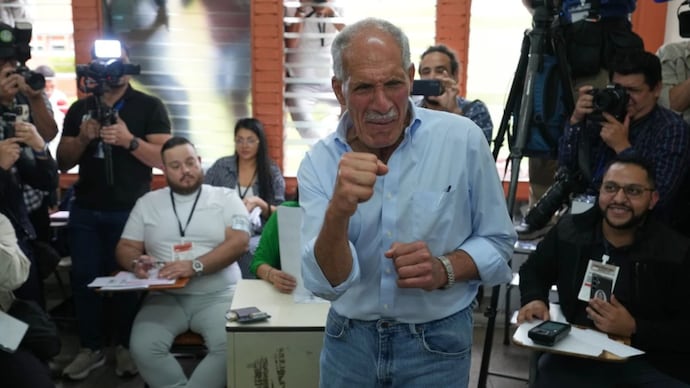
Nasry Asfura, presidential candidate for Honduras’ Party, gestures as he participates in general election activities in Tegucigalpa on November 30, 2025. (AP Photo)

New Delhi,UPDATED: Dec 25, 2025 04:08 IST
After weeks of uncertainty and a slow vote count, Honduras’ electoral authorities on Wednesday declared Trump-backed conservative Nasry Asfura the winner of the presidential election, bringing an end to a turbulent and closely watched contest.
The outcome adds to a growing rightward shift across Latin America and comes just days after Chile elected far-right politician Jos Antonio Kast as its next president.
Asfura, a candidate from the conservative Party and the former mayor of Tegucigalpa, secured 40.27 percent of the vote in the November 30 election, narrowly defeating four-time contender Salvador Nasralla of the Liberal Party, who finished with 39.53 percent.
The margin capped a tense, weeks-long count that kept the country in political limbo and sparked growing international concern. During the prolonged process, Asfura and Nasralla remained virtually tied, fueling allegations of irregularities and heightening scrutiny of election authorities, the Associated Press reported.
Celebrations broke out at Asfura’s campaign headquarters late Tuesday, even as disputes over the results continued elsewhere.
“Honduras: I am prepared to govern,” Asfura wrote in a post on X shortly after the final numbers were released. “I will not let you down.”
A SETBACK FOR HONDURAS' LEFTIST GOVERNMENT
The results marked a sharp rebuke to the country’s current leftist leadership. The governing Liberty and Re-foundation Party, known as LIBRE, saw its candidate trail far behind with just 19.19 percent of the vote.
US Secretary of State Marco Rubio congratulated Asfura on Wednesday, saying in a post on X that “the people of Honduras have spoken” and adding that the Trump administration looked forward to working with the incoming government “to advance prosperity and security in our hemisphere.”
Several right-leaning leaders across Latin America echoed those congratulations, including Argentine President Javier Milei, a close Trump ally.
Asfura campaigned as a pragmatic manager, pointing to popular infrastructure projects completed during his tenure as mayor of the capital. Just days before the vote, Donald Trump publicly endorsed the 67-year-old conservative, saying he was the only Honduran candidate the US administration would work with.
Fraud claims and accusations of interference
Nasralla rejected the outcome, maintaining that the election was fraudulent and calling for a full recount just hours before the official results were announced.
In a pointed message addressed to Trump on X, Nasralla accused Asfura of suppressing votes.
“Mr. President, your endorsed candidate in Honduras is complicit in silencing the votes of our citizens,” Nasralla wrote. “If he is truly worthy of your backing, if his hands are clean, if he has nothing to fear, then why doesn’t he allow for every vote to be counted?”
Nasralla and other opponents have argued that Trump’s last-minute endorsement amounted to electoral interference and ultimately tipped the race.
A CHAOTIC COUNT DEEPENS TENSIONS
The election itself was marred by an unusually slow and disjointed vote count. Honduras remained in limbo for more than three weeks as electoral authorities struggled to finalize tallies. At one point, the process stalled entirely after officials called for a special count of final votes, prompting warnings from international observers.
Ahead of Wednesday’s announcement, Organization of American States Secretary General Albert Rambin issued an “urgent call” for Honduran authorities to complete the count before a December 30 deadline. The Trump administration also warned that any effort to obstruct or delay the process would carry “consequences.”
A RECKONING FOR THE INCUMBENT PRESIDENT
For Honduras’ progressive president, Xiomara Castro, the election amounted to a political reckoning. Castro, elected in 2021 on promises to curb violence and root out corruption, had already acknowledged last week that she would accept the results — even after accusing Trump of staging what she called an “electoral coup.”
Castro was part of a wave of left-leaning leaders elected across Latin America roughly five years ago on platforms of reform and renewal. Many of those governments are now facing voter backlash over unmet expectations.
- Ends
With inputs from Associated Press
Published By:
Aashish Vashistha
Published On:
Dec 25, 2025