 2 hours ago
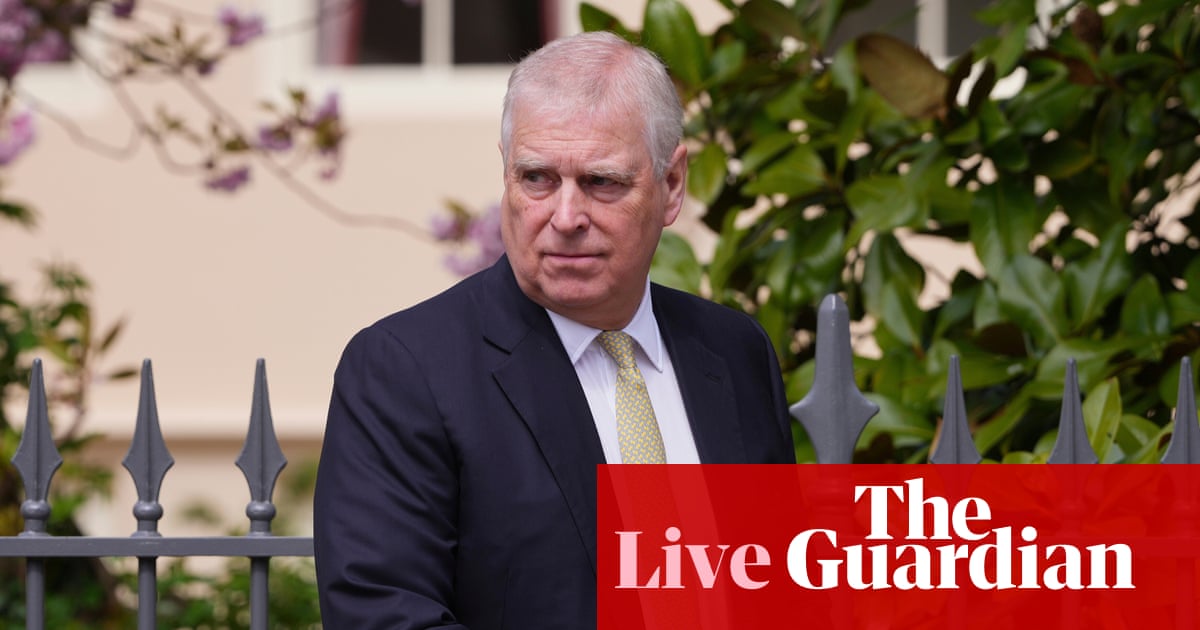
MPs pass Lib Dem humble address motion saying papers relating to Andrew being made trade envoy must be published
After Chris Byrant finished, the Lib Dem humble address motion was passed without a division. That means the government is now obliged to comply with it.
Here again is the text of it.
That an humble address be presented to His Majesty, that he will be graciously pleased to give directions to require the government to lay before this house all papers relating to the creation of the role of special representative for trade and investment and Andrew Mountbatten-Windsor’s appointment to that role, including but not confined to any documents held by UK Trade and Investment, British Trade (BTI) and its successors, the Foreign, Commonwealth and Development Office, the Cabinet Office and the prime minister’s office containing or relating to advice from, or provided to, the group chief executive of BTI, Peter Mandelson, the Cabinet Office and the prime minister regarding the suitability of Andrew Mountbatten-Windsor for the appointment, due diligence and vetting conducted in relation to the appointment, and minutes of meetings and electronic communications regarding the due diligence and vetting.
Key events now Reform UK criticised over plan to use council pension fund money as British sovereign wealth fund 26m ago Threat of foreign interference in UK politics, including from US, getting worse, MPs warn, as they call for crypto gifts ban 1h ago Emma Reynolds tells farmers SPS deal with EU should make exports 'faster, easier and cheaper' 2h ago Ukrainian refugees in UK given longer to extend visas after complaints 28-day application window too short 2h ago MPs pass Lib Dem humble address motion saying papers relating to Andrew being made trade envoy must be published 2h ago Bryant says government working 'at pace' on legislation to remove Andrew from line of succession 2h ago Bryant expresses doubts about Lib Dem call for two-part inquiry into Epstein's links with UK 2h ago Lammy says courts will increase use of AI to 'smash through delays' 3h ago Rupert Lowe fails in effort to block investigation by MPs’ watchdog 3h ago Lib Dems call for public inquiry into Epstein's links with British establishment 3h ago Liam Byrne confirms Commons business committee may launch Andrew inquiry after police probe over 3h ago Lib Dems say humble address vote 'important step in dismantling system that protected Andrew' 4h ago Bryant says Tory ministers and prominent journalists were defending Andrew in 2011 when warning signs already clear 4h ago Andrew 'rude, arrogant and entitled man' who could not distinguish between public and personal interest, says Bryant 4h ago Bryant says those who turned blind eye to Epstein 'out of greed, familiarity or deference' were complict in his crimes 4h ago Trade minister Chris Bryant tells MPs government will support Lib Dem motion for publication of Andrew trade envoy papers 5h ago Davey says Epstein tried to use Andrew's trade envoy job 'to enrich himself' 5h ago Davey says publication of Andrew documents under humble address should not jeopardise police inquiry 5h ago Speaker Lindsay Hoyle urges MPs to exercise 'restraint' in Andrew debate given police investigation 5h ago UK suffering from 'totally unregulated sexual economy', says Reform UK's Danny Kruger, arguing for pro-family policy 5h ago Reform UK accused of declaring war on workers and renters after Tice says he would repeal Labour's jobs and housing laws 6h ago Badenoch cites Roblox as problem for children as she says teen social media ban has to take account of how platforms work 6h ago Badenoch says she expects Lib Dem motion demanding release of Andrew trade envoy documents to pass without need for vote 7h ago Badenoch revives call for under-16s social media ban at event with families who have lost childen after online abuse 7h ago NFU president Tom Bradshaw calls for farm inheritance tax to be abolished in full 7h ago Starmer tells cabinet 'we must defeat falsehood Russia is winning', as he pays tribute to Ukraine's 'incredible resilience' 8h ago Reform mayor courted US oil and gas executive about fracking in UK 9h ago Ed Davey apologises for praising Andrew's 'excellent' work as trade envoy in Commons debate 15 years ago 9h ago Minister signals No 10 won't stop MPs voting to publish Andrew trade envoy papers - provided police probe not jeopardised Show key events only Please turn on JavaScript to use this feature
Reform UK criticised over plan to use council pension fund money as British sovereign wealth fund
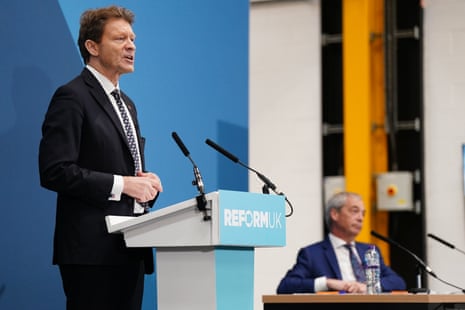
In his speech in Birmingham today, Richard Tice, Reform UK business spokesperson, announced two proposals relating to pensions that are now attracting much critcism.
First, he proposed pooling funds in the local government pension scheme and using them to fund a new British sovereign wealth fund, which would manage assets of up to £575bn. He said:
I’ve been looking closely at the local government pension scheme that has assets of about £500 billion, covering 98 funds across councils across the whole of the UK, and it’s got some seven, three quarter million members, well intentioned, but being woefully managed in a completely disparate, uncoordinated way, with no vision, no purpose of backing Britain whatsoever, and it’s been massively overcharged over inflated fees to the tune of four or five times, whilst it’s underperforming hugely, never meeting the benchmarks …
We can transform this into a British Sovereign Wealth Fund, proudly paying all of the members and pensioners, of course, whilst patriotically backing Britain all of the way.
And, second, he confirms that Reform UK wants to end defined benefit pensions for new council staff, replacing them with defined contributions ones, which are considerably less generous.
On the sovereign wealth fund plan, Pensions UK, a group representing fund managers and others in the pensions industry, says Tice’s plans are concering.
Zoe Alexander, executive director of policy and advocacy at Pensions UK, said:
We simply do not recognise the picture of the local government pension scheme (LGPS) that Reform UK has painted.
The LGPS is one of the largest and most successful pension schemes in the world. It is fully funded and undergoing a major reform programme to consolidate its assets into six large investment pools ranging from £25-100bn, with savings to date estimated at £1bn, and with further savings to come. It is an exemplar of UK investment amongst pension schemes, with an allocation of around 17%. LGPS investment performance for England and Wales has been strong, with the scheme having achieved a return of around 7% pa over the last decade.
Reform’s proposals are lacking in detail, but its intentions to place all new staff into a defined contribution scheme and to transform the scheme into a sovereign wealth fund are concerning.
The LGPS exists solely to fund the retirements of close to 7 million local government workers, many of whom are low earners. It does not exist to manage a pool of assets to fund government projects.
And the UK Sustainable Investment and Finance Association was also critical. Its CEO, James Alexander, said:
Proposals to force pension schemes to invest in the UK run the risk of distorting markets and creating asset bubbles.
They could also lead to lower returns for savers, at a time when shortfalls in retirement pots have left a whole generation facing a later-life income crisis. This stands to affect workers across the economy, including those now close to leaving employment.
And, on ending defined benefit pensions for council staff, the Unison general secretary Andrea Egan said:
Attacking the pensions of council staff is a disastrous move. Employees would be denied a secure retirement income and it would worsen the recruitment crisis in local government.
Whether it’s targeting low-paid staff or demonising anyone from overseas, Reform has little interest in helping workers or strengthening public services.
Threat of foreign interference in UK politics, including from US, getting worse, MPs warn, as they call for crypto gifts ban
Parliament’s joint committee on the national security strategy has called for a temporary ban on political parties accepting cryptocurrency donations.
In a letter to Steve Reed, who as housing, communties and local government secretary is in charge of electoral law, it suggests the government should legislate for a temporary ban in the representation of the people bill.
And, in the meantime, the Electoral Commission should issue tougher guidance for parties that are accepting crypto donations, it says.
Matt Western, the Labour MP who chairs the committee and who wrote the letter, said that tigher rules were needed because the threat of foreign states interferring in UK politics was growing. He wrote:
We are concerned that foreign state intent to interfere in UK political finance may grow out to the next election. As the security environment worsens and the UK’s military role in Europe grows, the value of influencing the UK’s political positions (for example on Ukraine, or US/EU relations) is likely to increase.
The challenge now goes beyond adversaries and third countries seeking influence. The US administration has outlined ambitions to shape political discourse in allied countries.
And the corrosive public belief that foreign influence could affect democratic processes is in itself a significant risk to long-term trust in institutions, regardless of whether foreign efforts actually affect outcomes.
We therefore urge you to exploit the current legislative vehicle and associated political momentum more effectively.
Western does not name any parties that pose a particular risk – although Reform UK is the only main party that actively solicits donations in crypto.
In his letter, Western admitted that experts are divided on the case for a ban on crypto donations. But he said the bill (which is primarily about legislating for votes at 16) should include a temporary ban on crypto donations – to remain in place until the Electoral Commission produces new statutory guidance on this topic.
In the meantime, the commission should produce “more comprehensive interim guidance” on crypto, Western said.
The Electoral Commission has already complained that the bill does not do enough to tighten the rules designed to stop foreigners donating to political parties via UK companies. In his letter, Western said the bill should be strengthened in this area.
Western also called for longer sentences for people who break party funding laws, saying the Crime Agency has complained there is a limit to what they can do to investigate these offences because intrusive covert surveillance powers can only be used in relation to crimes that attract a sentence of three years or more.
Emma Reynolds tells farmers SPS deal with EU should make exports 'faster, easier and cheaper'

Helena Horton
Emma Reynolds, the environment secretary, has promised to boost the British farming sector with more EU trade.
Speaking at the NFU conference in Birmingham, she said there would be “more British beef and dairy on European tables” and bemoaned the fact trade with the EU has diminished by 20% since Brexit.
She said a new sanitary and phytosanitary (SPS) agreement with the EU, coming later this year, will “reduce trade frictions”, adding:
It will make trade faster, easier and cheaper – frictionless trade, efficient orders, open supply chains. We know that you want more detail on what the agreement will look like, and we will be setting that out soon.
However, one agreement was less welcomed; some farmers will lose money by opting into environment schemes under new plans to cap payments announced by Reynolds at the conference.
After Brexit, England moved from a system where farmers were subsidised based on how much land they managed to one where they would be paid for delivering environmental benefits.
This was paid based on an “income foregone” basis, meaning farmers would never be out of pocket for digging ponds, planting trees, or sowing wildflower seeds on previously intensively farmed land.
Now the government is introducing caps in order to make the system fairer. No farm will be allowed to claim more than £100,000 a year from the schemes. For some larger farms and estates, this will probably mean they put land back into food production.
Jake Fiennes, head of conservation at the Holkham Estate, who was one of the first pilot schemes for the new environmental land payments, said:
With this new policy, there is all the potential of some wonderful work delivering for the environment being undone.
He said larger farms and estates, which had put much of their land into environmental schemes, would be disincentivised to keep those projects going for the long term.
Many major schemes are due to end in December. These will have a significant environmental value and the resultant change in income driven by this policy will probably mean a reduction in environmental output in these areas. Some of which have been committed to improving the environment for decades.
Under the new government plans, smaller farms under 50ha will be prioritised for funding. The Department for Environment, Food and Rural Affairs said this is because 25% of funding went to 4% of farms previously.
Ukrainian refugees in UK given longer to extend visas after complaints 28-day application window too short

Chris Osuh
Chris Osuh is a Guardian community affairs correspondent.
Ukrainians who have fled war have been given longer to renew their UK visas after concerns the process was creating gaps in which people were unable to prove their right to live and work legally.
Refugees who left the European country and came to the UK after the outbreak of war with Russia now have 90 days to extend their visas.
Under the previous extension scheme Ukrainians had to wait to apply to extend their visa when their current permission had 28 days or less remaining until it expired and, if they applied earlier, they could be rejected and have to reapply.
Campaigners had said the short window meant people were being refused tenancy renewal because their visas were about to expire, while others had been told they would have to stop working during the extension process as landlords and employers feared fines and sanctions.
The announcement that the timeframe for the visa extension period was being increased came on the fourth anniversary of the Russian invasion of Ukraine.
Migration minister Mike Tapp told Ukrainians the UK “will remain your safe haven for as long as the war continues”.
There were 278,529 visas issued between the Ukraine schemes opening in 2022 and the end of September last year, according to the latest Home Office data published in November.
Tapp said:
We have listened to the concerns of the Ukrainian community and acted to offer greater peace of mind ... Britain will always offer sanctuary to those in genuine need.
MPs pass Lib Dem humble address motion saying papers relating to Andrew being made trade envoy must be published
After Chris Byrant finished, the Lib Dem humble address motion was passed without a division. That means the government is now obliged to comply with it.
Here again is the text of it.
That an humble address be presented to His Majesty, that he will be graciously pleased to give directions to require the government to lay before this house all papers relating to the creation of the role of special representative for trade and investment and Andrew Mountbatten-Windsor’s appointment to that role, including but not confined to any documents held by UK Trade and Investment, British Trade (BTI) and its successors, the Foreign, Commonwealth and Development Office, the Cabinet Office and the prime minister’s office containing or relating to advice from, or provided to, the group chief executive of BTI, Peter Mandelson, the Cabinet Office and the prime minister regarding the suitability of Andrew Mountbatten-Windsor for the appointment, due diligence and vetting conducted in relation to the appointment, and minutes of meetings and electronic communications regarding the due diligence and vetting.
Bryant says government working 'at pace' on legislation to remove Andrew from line of succession
Bryant also said that the government was working “at pace” on legislation to remove Mountbatten-Windsor from the line of succession. He said went on:
We intend to be able to bring forward legislation when we can.
I can’t commit to a particular date on that, but I note that Julie Andrews in The Sound of Music sang, “I have confidence that spring will come again.” And so I have confidence that the act of succession will come round at pace.
He ended by saying that, although it would be nice to pretend otherwise, it was likely that young people were still be abused today “by rich, wealthy, arrogant, entitled people”.
The government should do all in its power to stop that happening, he said. But he said ultimately it was for the legal process to ensure offenders were caught and punished.
Referring to criticism of the parliamentary rules that have protected the royals from criticism, Bryant said that even under the current rules it is possible to hold a debate on a member of the royal family, if one of the main parties table a substantive motion. But that did not happen with Andrew Mountbatten-Windsor, he said.
And he said there had been criticism of the sub judice rules. But it said it was important for MPs to respect these, so they did not say anything that might prejudice a trial. He said it was for the courts to find people guilty, not parliament.
Bryant expresses doubts about Lib Dem call for two-part inquiry into Epstein's links with UK
In the Commons Chris Bryant, the trade minister, is now winding up the humble address debate.
He thanks the Lib Dems for bringing the debate to the Commons.
He repeated the government’s intention to comply with the humble address motion “as soon as is practical within the law”.
But, in terms of delaying the release of information, he says the government would be guided by the advice of the prosecuting authorities.
Referring to the Lib Dem call for a public inquiry (see 3.13pm), he says that in 2011, as well as criticising Prince Andrew (see 1.49pm), he was also exposing phone hacking. That led to a public inquiry. It was meant to take part in two parts (as the Lib Dems propose this one could). But the police investigation went on for so long that part two never took place.
So he was “somewhat cautious” about calls for another two-part inquiry.
Lammy says courts will increase use of AI to 'smash through delays'
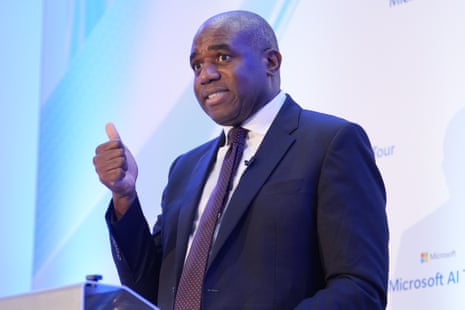
The Ministry of Justice will ramp up use of artificial intelligence (AI) in courts to cut backlogs, David Lammy, the deputy PM and justice secretary has said. As the Press Association says, Lammy backed digital modernisation across the courts system, including using AI to keep notes and summarise judgments. PA says:
Lammy gave a speech at the Microsoft AI Tour in London where he said the Ministry of Justice (MoJ) is one of the fastest-growing users of Microsoft’s AI-powered assistant, Copilot.
He told the audience that new technology like AI will help the court system “smash through delays, cut complexity, and free up people to do what they do best”.
Lammy, a former barrister, said an AI tool had already been piloted in the probation service to record meetings between officers and offenders, removing the need for handwritten notes to be typed up.
The MoJ will also explore using AI to speed up case progression by transcribing material and summarising their judgments.
Pledging to increase spending on AI, Lammy said: “I want to see more AI initiatives like these. We’re going to invest more in our in-house, justice AI unit. A specialist team within my department, working with staff to tackle the challenges that they face.
“Over £12m in additional funding in the next financial year will expand our AI capabilities, putting this powerful tool finally in the hands of staff.”
Lammy said the MoJ’s relationship with Microsoft and others will represent an “unprecedented partnership between the public and private sectors”.
Technology will also be used to get defendants to court faster, Lammy said.
Prison transport vehicles will be able to use the same technology that switches traffic lights green as emergency vehicles approach in some areas, he said.
Lammy also said the cap on court sitting days will be lifted.
As Jessica Elgot reports, the Ministry of Justice has released figures suggesting that, even with all the measures being taken to speed up the criminal justice process, clearing the backlog in criminal courts will take a decade.
Rupert Lowe fails in effort to block investigation by MPs’ watchdog
A high court judge has dismissed an attempt by the independent MP Rupert Lowe to block a parliamentary watchdog from investigating a complaint against him, Kevin Rawlinson reports.
Lib Dems call for public inquiry into Epstein's links with British establishment
In the Commons Daisy Cooper, the Lib Dem deputy leader, has just made an intervention to say that a public inquiry into Andrew Mountbatten-Windsor and other Jeffrey Epstein links with the UK could take place in two parts – with some parts delayed until after criminal proceedings, and some parts happening more quickly. She said there was precedent for inquiries being split into two parts.
Cooper intervened in a speech being given by her Lib Dem colleague Lisa Smart, who said the Lib Dems were “fizzing with ideas” about how systems could be improved in the light of this scandal. She said the inquiry should cover Epstein and his links with the British establishment.
Back in the Commons, the humble address debate is still going on, but it has now become a Lib Dem-only affair. We have only had speeches from two Labour MPs (the minister, Chris Byrant, and Rachael Maskell), one Conservative (the frontbencher Alex Burghart), one SNP MP (Brendan O’Hara) and one Green MP (Siân Berry). All the other speakers have been Lib Dems, and now the only MPs being called are Lib Dems. It is their motion after all.
Many of them are saying the release of the Andrew documents is not enough, and public inquiry is needed.
Liam Byrne confirms Commons business committee may launch Andrew inquiry after police probe over
Liam Byrne, the Labour chair of the Commons business committee, has said that his committee may launch an inquiry covering Andrew Mountbatten-Windsor’s work as a trade envoy when the police inquiry is over.
Speaking at the start of an unrelated committee hearing today, he said the committee would “begin gathering information immediately so that we might stand ready to launch an inquiry into the governance regime for trade envoys at the moment the police and criminal justice system action has concluded”.
The committee will write to ministers on the issue “and we will come back to the house with our opinion about whether an inquiry should be launched, depending on the information we receive”.
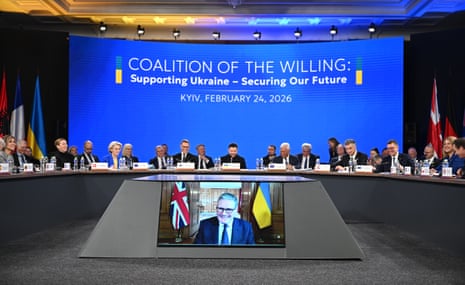
Keir Starmer participated online this morning in a coalition of the willing meeting about Ukraine. He was one the co-chairs, along with Emmanuel Macron of France and Friedrich Merz and afterwards, on behalf of the more than 30 leaders who took part, they issued a statement saying the leaders “offered their full and sustained support as Ukraine fights for its sovereignty and territorial integrity, and to defend Europe’s freedom”.
Jakub Krupa and Shaun Walker have more about the meeting on the Europe live blog. Shaun, the Guardian’s central and eastern Europe correspondent, is doing a Q&A with readers.