1 hour ago
India still ranks among the world's biggest arms importers. But from Astra and BrahMos to Akash and Pinaka, its growing defence exports are steadily redrawing that image across Asia and beyond.
For decades, India has been one of the world's largest arms importers, relying heavily on foreign suppliers to modernise its military. Even today, it remains among the world's biggest arms buyers. Every major defence export, therefore, represents more than a commercial transaction.
The latest indication of that shift came during Prime Minister Narendra Modi's visit to Indonesia, where the two countries announced cooperation on the BrahMos Missile System and signed an Air-to-Air Missile Cooperation Agreement.
While BrahMos has become the face of India's defence exports, the second agreement has brought renewed attention to Astra, India's indigenous beyond visual range air-to-air missile, which is expected to become the country's next major missile export.
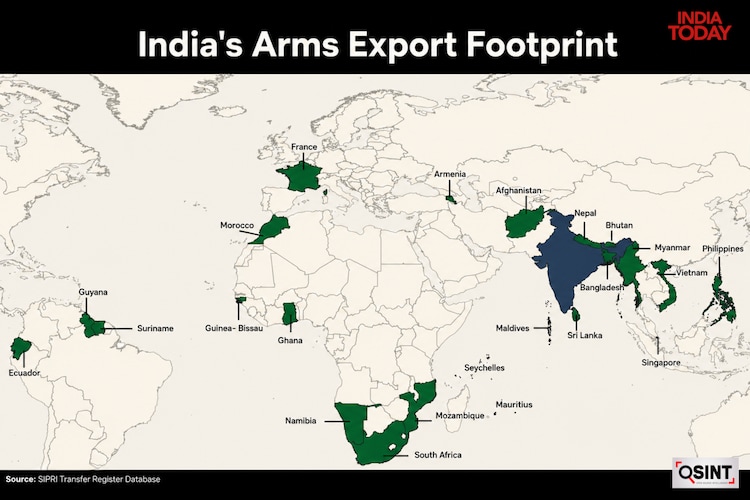
To understand the scale and direction of India's expanding defence exports, India Today's Open Source Intelligence (OSINT) team analysed official government data alongside publicly available arms transfer records from the Stockholm Peace Research Institute (SIPRI), an independent research institute that tracks global arms transfers.
A Ministry of Defence report, “A Decade of Defence Reforms: Transforming India's Military Landscape”, places defence exports at the centre of India's push for self-reliance. According to the report, exports increased from Rs 686 crore in FY2013-14 to Rs 38,424 crore in FY2025-26, with Indian made defence products now reaching more than 80 countries.
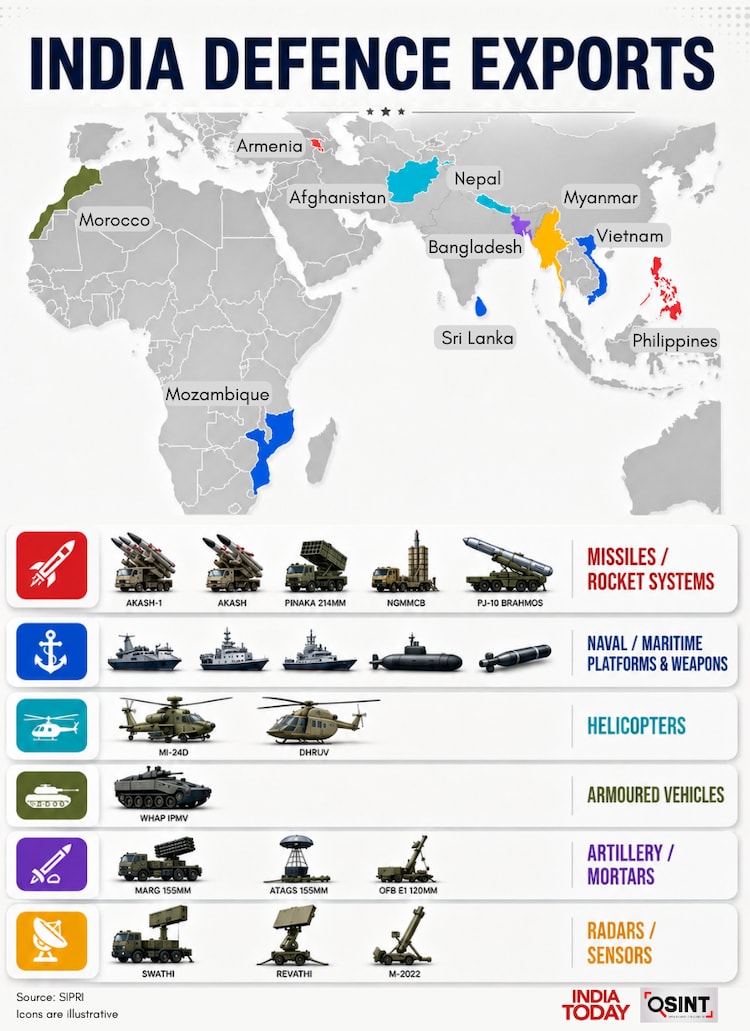
While the Ministry's figures capture the broader defence export ecosystem, SIPRI's Arms Transfers Database presents a more granular picture of major conventional arms. The database identifies 23 recipient countries for Indian military equipment, reflecting how exports have diversified beyond a handful of flagship systems into multiple categories of military hardware.
A closer look at the export basket reveals which platforms are driving this growth and where they are going.
The latest milestone in India's missile export journey could come through Astra Mk1. Today’s agreement has fuelled expectations that Indonesia could become the first foreign customer for the indigenous beyond visual range air-to-air missile, marking another step in India's defence export ambitions. The deal is also strategically significant, as Indonesia is one of India's key ASEAN partners under New Delhi's Act East Policy.
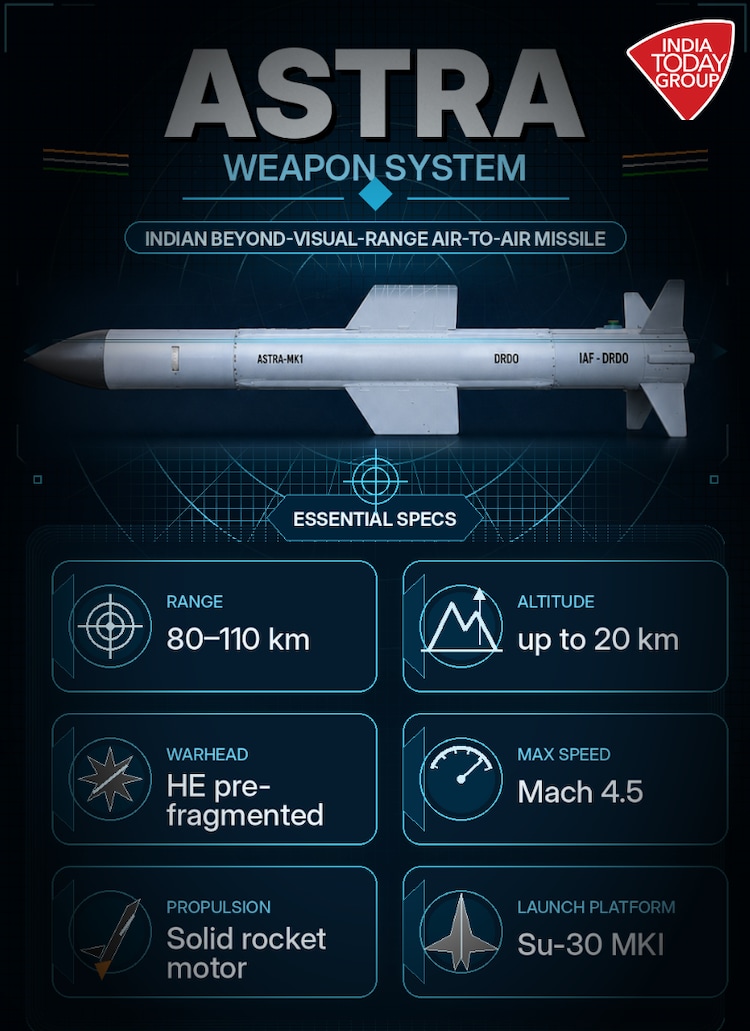
Developed by the Defence Research and Development Organisation (DRDO), Astra is India's first indigenously developed beyond-visual-range air-to-air missile (BVRAAM). Inducted into the Indian Air Force in 2019, the missile is designed to engage highly manoeuvrable fighter aircraft beyond visual range in all weather conditions.
Astra Mk1 has a strike range exceeding 100 km and has been integrated with the Su-30 MKI fighter aircraft. In July 2025, DRDO and the Indian Air Force successfully validated the indigenous seeker during flight trials, with the missile destroying high-speed aerial targets under varying engagement conditions.
At the centre of India's defence export story, however, remains the BrahMos missile system. Jointly developed by India and Russia, the supersonic cruise missile became India's first major weapon system to secure an export contract. Following agreements with the Philippines and Vietnam, Indonesia has now signed a cooperation agreement on the BrahMos Missile System, signalling the missile's expanding footprint across Southeast Asia.
The missile's profile received a further boost after Operation Sindoor, where BrahMos was employed in precision strikes against targets inside Pakistan, reinforcing confidence in its operational performance. That battlefield validation has strengthened its appeal as India seeks to expand exports of high-end weapon systems across the Indo-Pacific.
India's missile export portfolio is no longer limited to offensive strike systems. It now extends to indigenous air defence capabilities through the Akash Weapon System, which became India's first indigenous surface-to-air missile system to secure an overseas customer.
Developed by DRDO, Akash is a short-range surface-to-air missile system designed to protect strategic assets from fighter aircraft, helicopters, cruise missiles and unmanned aerial vehicles.
Operational with both the Indian Army and the Indian Air Force, Armenia became the first foreign customer for the system.
Another indigenous platform entering overseas markets is the Pinaka Weapon System, a DRDO-developed multi-barrel rocket launcher. Designed for rapid, high-volume fire support, Pinaka can strike troop concentrations, communication centres, airfields and logistics infrastructure using multiple types of ammunition, including precision-guided rockets. SIPRI records identify Armenia as its first overseas recipient.
India's defence exports extend well beyond missile systems. SIPRI records show Indian built naval and maritime platforms reaching countries across the Indian Ocean Region, including the Maldives, Mauritius, Mozambique, Myanmar, Seychelles, Sri Lanka and Vietnam. These exports include Do-228 maritime patrol aircraft, L&T Fast Interceptor Craft, FPV-300 patrol vessels, Samarth, Shyena anti-submarine systems and Khukri class platforms, highlighting India's growing role as a supplier of maritime security assets.
The database also records exports of Dhruv Advanced Light Helicopters and Mi-24D helicopters to Afghanistan, Maldives, Mauritius and Nepal; WhAP Infantry Protected Mobility Vehicles to Morocco; artillery systems including ATAGS, MArG and OFB E1 mortars to Armenia and Bangladesh; and Swathi Weapon Locating Radars, Revathi and M-2022 radar systems to Armenia, Myanmar and Seychelles.
Among those destinations, Armenia has emerged as one of India's most significant defence partners. As Davit Khachatryan writes for the Lieber Institute's Articles of War at the United States Military Academy, West Point, “the 2020 Nagorno-Karabakh War and concerns over Russia's ability to meet its defence commitments prompted Armenia to diversify its security partnerships and defence procurement."
According to Khachatryan, India accounted for 43 per cent of Armenia's total weapons imports between 2022 and 2024, making the country India's largest single arms export customer by value. The procurement relationship now spans Pinaka multi-barrel rocket launchers, Akash-1S air defence missiles, ATAGS howitzers and Swathi weapon locating radars, illustrating how India's indigenous defence industry is increasingly translating domestic capability into strategic partnerships overseas.
- Ends
Published By:
bidisha saha
Published On:
Jul 7, 2026 19:02 IST