56 minutes ago
Burnham hits back at Blair, saying ex-PM does not understand how 'wide inequality' driving voter anger
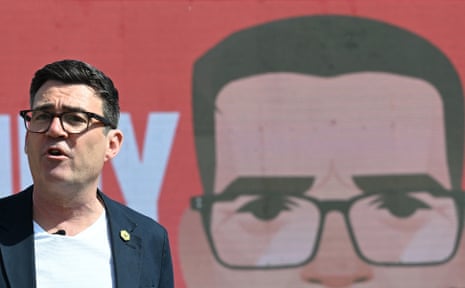
It turns out we did not have to wait until tomorrow. (See 1.20pm.) Andy Burnham has given his response – or at least an initial response – to Tony Blair’s essay in an interview with Rachel Sylvester from the Observer.
Burnham said Blair had ignored the problems caused by widening inequality over the past 40 years. Burnham argued:
[Blair] doesn’t mention inequality once. If you don’t get how that’s driving politics now, if you are not rooting your analysis in the fact that people are unable to live and that things that were taken for granted are no longer affordable, then you are not understanding what’s going on.
Blair has criticised Burnham for arguing that politics has failed to deliver people for the past 40 years. (See 9.43am.) But Burnham said policies over the past 40 years delivered “wide inequality” and that was “responsible for the abandonment of the centre”. He went on:
People don’t think the centre has delivered for them in terms of their lives, therefore they’ve gone further to the extremes.
Burnham said that Blair was wrong to suggest the private sector was always more effective at delivering services than the state. He said:
Tony seems to argue that the private sector has all-encompassing reach into everything, and when it comes to essential services the evidence is pretty clear it isn’t the fix.
Burnham said sometimes politicians needed to be pro-business, and sometimes they needed “a more left solution”.
Blairism sometimes saw the market as always the answer. That’s its problem.
He also criticised two aspects in particular of Blair’s legacy as PM.
Blair put too much emphasis on getting children to go to university, he said:
The prioritisation of universities is a significant part of the problem that has left out too many people and has impacted on the welfare system.
And he said that Blair failed to find a solution to social care, despite declaring in his 1997 Labour conference speech that he did not want his children to grow up in a country where old people have to sell their homes to pay for social care (which remained the position when he left office 10 years later, and remains the position today).
Key events Show key events only Please turn on JavaScript to use this feature
Ed Davey says it's 'utter disgrace' government still trying to withhold information about Mandelson's vetting
Ed Davey, the Lib Dem leader, has been reading the Guardian’s scoop about why UK Security Vetting thought Peter Mandelson should not get vetting approval to allow him to become ambassador to the US. (See 2.42pm.) He says he is alarmed by the reports saying that the summary of the vetting report may not be fully released.
In a statement he says:
The fact that the government is still trying to hide the truth when it comes to Mandelson is an utter disgrace. I can only imagine how angry Keir Starmer would be about it if he weren’t running the government.
The responsibility for the hiring of Peter Mandelson lies at the door of the prime minister. Number 10 knew full well about Mandelson’s business relationships with China and Russia, and indeed with Jeffrey Epstein too.
Glaring warning signs were wilfully ignored, driven by a desperate desire to pander to the bully in the White House rather than protect British interests.
John Crace has also written up his take on the Tony Blair essay. He has satirised it as a digested read.
Government rejects proposal to allocate funds for domestic homicide reviews
The Home Office has rejected a proposal to allocate government funds for reviews into domestic abuse-related deaths, Geraldine McKelvie reports.
Larry Elliott on why Blair's 'Labour and the future' essay is a 'flawed analysis'
Larry Elliott, the Guardian’s former economics editor, has written a very good assessment of Tony Blair’s ‘Labour and the future’ essay. He says that, while the former PM is right about some points, he does not realise quite how much the world has changed since he left office in 2007. Overall, it’s a “flawed analysis", Larry says.
It is one part nostalgia for a golden Blairite era that never was, one part belief that AI is the answer and one part failure to accept that the current crop of Labour politicians might be on to something.
Here is the column in full.
And here is Larry’s conclusion.
Blair’s advice to Labour is that it should occupy the centre ground of politics, snuggle up to big business, get people off welfare, fully embrace AI – and that it should have chosen to raise VAT rather than national insurance. This is fantasy-island stuff. Apart from anything else, there is a failure to accept that the centre ground of politics has shifted to the left as voters have become ever-more dissatisfied by a model that only seems to deliver for the better off.
If Starmer is furious with Blair he has every right to be. When you are fighting for your political life it is unhelpful – to say the least – to have one of your predecessors lobbing bricks at you. As Clement Attlee once said to one of his critics: “A period of silence on your part [would] be welcome.” In truth, Starmer’s inability to connect with voters means he is doomed anyway.
Yet it is not serious politics to suggest that the present government could rip up its manifesto pledges, take the axe to the welfare bill, ignore the egregious behaviour of the privatised utility companies, pretend the climate crisis isn’t happening and move closer to Donald Trump.
Labour, Blair says in his essay, has an “almost infinite capacity for self-delusion”. That may well be true. But if the former prime minister thinks he here has the solution to Britain’s problems, no one is more deluded than he is.
Burnham hits back at Blair, saying ex-PM does not understand how 'wide inequality' driving voter anger
It turns out we did not have to wait until tomorrow. (See 1.20pm.) Andy Burnham has given his response – or at least an initial response – to Tony Blair’s essay in an interview with Rachel Sylvester from the Observer.
Burnham said Blair had ignored the problems caused by widening inequality over the past 40 years. Burnham argued:
[Blair] doesn’t mention inequality once. If you don’t get how that’s driving politics now, if you are not rooting your analysis in the fact that people are unable to live and that things that were taken for granted are no longer affordable, then you are not understanding what’s going on.
Blair has criticised Burnham for arguing that politics has failed to deliver people for the past 40 years. (See 9.43am.) But Burnham said policies over the past 40 years delivered “wide inequality” and that was “responsible for the abandonment of the centre”. He went on:
People don’t think the centre has delivered for them in terms of their lives, therefore they’ve gone further to the extremes.
Burnham said that Blair was wrong to suggest the private sector was always more effective at delivering services than the state. He said:
Tony seems to argue that the private sector has all-encompassing reach into everything, and when it comes to essential services the evidence is pretty clear it isn’t the fix.
Burnham said sometimes politicians needed to be pro-business, and sometimes they needed “a more left solution”.
Blairism sometimes saw the market as always the answer. That’s its problem.
He also criticised two aspects in particular of Blair’s legacy as PM.
Blair put too much emphasis on getting children to go to university, he said:
The prioritisation of universities is a significant part of the problem that has left out too many people and has impacted on the welfare system.
And he said that Blair failed to find a solution to social care, despite declaring in his 1997 Labour conference speech that he did not want his children to grow up in a country where old people have to sell their homes to pay for social care (which remained the position when he left office 10 years later, and remains the position today).
Resident doctors in England to go on strike over four days in June, BMA says
Resident doctors in England will strike from June 15-19 as part of their long-running dispute with the government over pay, the BMA said.
As the Press Association reports, the union announced the strike dates – and said there could be more to come in July – as it criticised the new health secretary, James Murray, for not improving the government’s offer.
Jack Fletcher, chair of the resident doctors committee, said:
We had hoped that a change in leadership at the Department of Health and Social Care would lead to a change in approach. Sadly, we have run up against the same unwillingness to move we encountered under Mr Streeting.
We were prepared to give Mr Murray time to settle into his role before completing the work his predecessor left unfinished – to both make a fair and meaningful pay offer and make concrete commitments to end the jobs bottleneck throttling the careers of our colleagues. He had a genuine opportunity to break this logjam with fresh energy and ambition.
He has not taken it. Instead, we are hearing the same tired line: vagueness on new jobs and no further money on the table. We cannot be asked to negotiate in good faith for weeks, only to be told there is nothing left to negotiate about on pay and no further details at this stage on jobs.
Revealed: Mandelson vetting warned of ties to senior figures in China, Russia and Israel
Peter Mandelson’s associations with senior figures in China, Russia and Israel were among the concerns raised by the UK’s vetting agency when it concluded he should be denied clearance, multiple sources have told the Guardian. Paul Lewis, Henry Dyer and Pippa Crerar say:
Mandelson’s links to China’s minister of finance, Lan Fo’an, the sanctions-hit Russian oligarch Oleg Deripaska and a former Israeli military intelligence general, Tamir Hayman, were all flagged by the agency as areas of concern shortly before he took up his post as the UK’s ambassador to the US, the sources said.
They added that United Kingdom Security Vetting (UKSV) also noted Mandelson had a very close relationship with a fourth individual, who is British, that could be compromising.
Another concern identified by the vetting agency, the sources said, was a £1m loan Mandelson received to invest in an Israeli startup. And UKSV noted separately, the sources added, that he appeared naive about the risk that historical relationships with other individuals could be exploited.
These concerns were all contained in a nine-page UKSV summary of Mandelson’s vetting file in January 2025, according to the sources, all of whom spoke to the Guardian on condition of anonymity.
And here is the full story.
Starmer says defence treaty with Poland will deliver 'generational uplift' in security relationship

Jakub Krupa
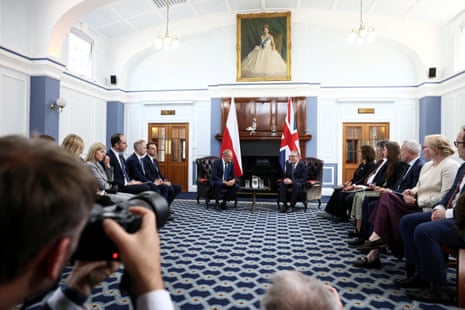
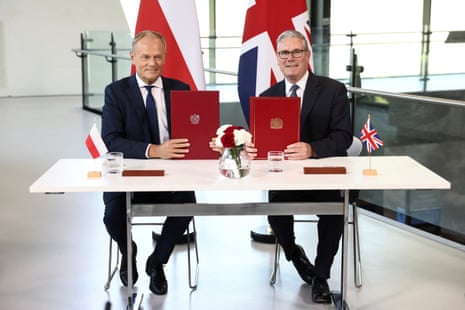
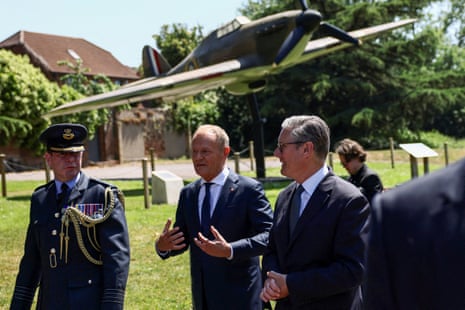
Keir Starmer and his Polish counterpart Donald Tusk have now signed the Polish-British defence and security treaty. (See 10:44am.)
After a brief signing ceremony at the Battle of Britain Bunker in west London – a nod to the Polish contribution to the Royal Air Force during the second world war – Starmer hailed the deal as a “generational uplift” in the UK’s defence relationship with Poland, saying it strengthened the relationship between the two countries “as we face the challenges of today.”
In particular, he referenced the continuing threat from Russia, which he said “we see that not just in Ukraine itself, but beyond Ukraine, impacting on our own countries.”
Tusk said the agreement was rooted in “our shared values,” and determination to “defend” both countries and its peoples.
He said the treaty would also strengthen “the European solidarity,” both through Nato and in the broader international context. He went on:
All of this gives hope that this unique, historical document, in this unique historical place, under the patronage of our pilots from 303 Squadron, will make our future safer. Thank you very much once again.
The deal focuses on defence and security issues, including mutual support and joint exercises, military procurement, air defence, cybersecurity, and broader infrastructure security.
Downing Street said it would include joint use of “uncrewed systems to reinforce Nato’s Eastern Flank”, and “accelerated” cooperation on tackling “malicious” disinformation.

Here are is some reaction to the Tony Blair article from journalists and commentators.
From Randeep Ramesh, the Guardian’s chief leader writer
Invoking Trump, Meloni and Milei as proof that voters want cults while insisting he is a sensible technocratic realist. This is Blairism with an AI wrapper: pro US, markets, deregulation, welfare cuts, techuptopia and impatience with democratic drag. Nah
From John Rentoul in a column for the Independent
This is Tony Blair’s most forceful intervention in British politics since he stepped down as prime minister nearly two decades ago …
[Blair] argues that the EU has adopted an approach to technology that is defensive and anti-growth; that Britain should adopt the opposite approach and then seek to persuade the EU.
That, he says, has been Labour’s mistake in government: to suppress growth instead of promoting it. To give business “headwinds, not tailwinds”. He offers a 10-point “wind of change” plan to raise productivity and to cut taxes and public spending.
Of course, he is right – or, at least, far more right than anyone else in British politics today, although I am not sure that a rise in VAT instead of Rachel Reeves’s national insurance increase would have been a good idea.
But who is going to make this plan work, if Starmer has failed and the two named candidates to succeed him are not up to the mark? Perhaps he is timing his intervention, in the lull in the Labour leadership frenzy, in the hope that someone else will emerge from the ranks to seize the moment with the boldness of the young Blair
From Will Hutton, the Observer columnist
Blair writes apparently ignorant of the work of Nobel prize winners Philippe Aghion and Angus Deaton. The tech revolution must be accompanied by a social contract revolution and the addressing of multiple inequalities. Otherwise it dies. Labour has to respect these realities.
From Stephen Bush in his Inside Politics column for the Financial Times
I doubt it’s going to come as a galloping shock to many readers when I say that I think this is an absolutely correct analysis of where Labour has gone wrong. The Starmer project never had anything like the level of serious intellectual revival that Labour went through in the 1990s or the Conservatives went through under Michael Howard and David Cameron in the 2000s.
I repeatedly wrote from 2022 to 2024 that Labour was storing up problems for itself by promising to deliver so much while ruling out many of the ways it could actually deliver anything. It was always going to back itself into introducing various growth-damaging tax rises having ruled out touching the big three (income tax, national insurance contributions and VAT). Coupled with its economic interventions, the outcomes were predictable and predicted.
From Sienna Rodgers from the House magazine
TB essay is refreshingly well-written, and spot on both in diagnosing the problem and analysing the appeal of the unconventional politician, but I think the proposals are less useful – either wrong (eg we should fully support whatever mad adventure Trump has decided to go on) or, mostly, very, very vague
Still, would be great to see the Labour leadership contenders do the same exercise
From Vicky Spratt, the housing journalist and campaigner
Something is glaringly absent from Tony Blair’s essay…any ideas on how to create policy for and messaging to sell the inevitable fiscal trade offs that now face any British government. Economic context is very, very different to when he became PM.
From Tim Shipman, the Spectator’s political editor
Whatever you think of Blair, engage with what he’s saying not how he makes you feel. The bare minimum we should expect from any leader is that they have an analysis of the current situation and a plan to deal with it which is as coherent and realistic as his intervention. Pretty well every critique I’ve read so far has failed to meet this requirement.
'Nothing to offer Labour' - leftwingers hit back at Blair over his policy essay
Tony Blair’s comments have not gone down well with the left. Here are comments about his essay, posted on social media, from various figures either in the Labour party, or associated with progressive politics or the left.
Richard Burgon, the Labour MP who is secretary of the Socialist Campaign Group, says Blair has nothing to offer the party.
Tony Blair has nothing to offer Labour in 2026.
His neoliberalism, backing of endless wars and acceptance of inequality are exactly what Labour must break from if it wants to rebuild support and defeat the far-right
Diane Abbott, who was elected as a Labour MP but who has had the whip suspended, says Blair’s ideas are wrong.
Blair has no coherent plan for the country. His policy framework is support every US war, cut welfare and pensions, deregulate and privatise, continue anti-migrant policies.
A hopeless, failed project.
Stewart Wood, a Labour peer and former adviser in No 10 to Gordon Brown, has posted a long thread analysing the essay. Here are some of his concluding points.
Blair’s essay is fundamentally optimistic about corporate power. It will bring wealth, opportunity & strength. It makes a big bet on the ultimate benevolence & responsibility of these corporate giants, or at least the alignment of their private interest with the public interest.
There has been a transformation in voter concern about unchecked corporate power. It is no longer a peccadillo of those of us on the left, but an animator of anger across the political spectrum. Much is misguided, much is not, but those pushing the Blair agenda cannot ignore it.
As usual with Tony Blair, his analysis on individual policy issues is essential reading (on Europe, China, on the NHS shifting to preventive care, on the problem of welfare reform, much else). And no doubt his prescription will understandably find a strong band of supporters.
But we should be clear on what his recipe is: embracing AI & Washington; very laisser-faire on regulation; cutting state intervention, taxes & spending; & optimism about the coincidence of private & public interest. I am sceptical this is the future Britain wants or needs. END
Harry Quilter-Pinner, director of the IPPR, a left-leaning thinktank that had close links with Blair’s government, says some of Blair’s ideas are worrying,
1/ There is lots to like in this. Blair is right that the Labour Party needs a debate about policy and about purpose not just personalities. He is right that the biggest weakness of this government has been a lack of what David Miliband calls ‘project’.
2/ But, some of his solutions are worrying. At a time when working people are struggling and rejecting the status quo, undoing things like workers rights and key elements of tax justice is a mistake. It’s true to New Labour - but not to the New Britain we now live in.
Steve Akehurst, director of Persuasion UK, a progressive thinktank focusing on public opinion, says he is sceptical of Blair’s ideas.
There is some decent stuff here but ‘people are leaving Labour for the Greens because they want ID cards’ is a level of self-delusion well beyond that which Blair accuses everyone else
I suppose a better faith interpretation is a ultra deliverist one - people are fleeing Lab because nothing works, here’s how you make stuff work. I admire the self-confidence, but would be useful to hear how you unite a modern electoral coalition behind an agenda cooked up on the slopes of Davos.
Jeremy Corbyn, the former Labour leader who is now parliamentary leader of Your Party, says Blair is wrong.
Tony Blair thinks the answer to this country’s problems is AI, welfare cuts and endless spending on war. Who benefits? Arms companies and tech billionaires. Once again, Blair is wrong. The answer is a redistribution of wealth and power and the relentless search for peace.
Zarah Sultana, another former Labour MP now in Your Party, says Blair is a war criminal.
The only statement Tony Blair should be making is a plea of “guilty” from the dock at The Hague.
He is a war criminal with the blood of over a million Iraqis on his hands
Yanis Varoufakis, the economics professor and former Greek finance minister, has used the essay as a peg to post a long statement denouncing Blair’s entire record.
Tony Blair is the living embodiment of what happens when political office becomes a down payment on future plunder …
Soon after, the Chilcot Inquiry demolished Blair’s Iraq lies, exposing him as a liar, a chancer and a war criminal responsible for countless corpses of Iraqis, but also of British soldiers.
Then came Blair’s real innovation: the financialisation of the ex-premiership itself. The Tony Blair Institute, fuelled by £130 million from Oracle’s Larry Ellison—coincidentally, the largest individual donor to the Friends of the IDF—became a shadow state, brokering governance contracts for autocrats and companies like Palantir that weaponise AI to produce mega-death abroad and full-on surveillance of Western populations.
Now, in May 2026, this corporate fixer issues a 5700 word tantrum demanding that Labour embrace Trump even more than Starmer already has, denounce what is left of Labour’s betrayed Green New Deal, and trash the remnants of workers’ rights. This is not the wisdom of an aging statesman. It is the frantic squirming of a man fearing his grip on oligarchic power might soon wane and whose entire post-10 Downing Street existence depends on preventing the many from ever reclaiming what the few have plundered.
Burnham says he will give 'considered response' to Blair's critique tomorrow
Andy Burnham says he is going to respond to the Tony Blair essay, and presumably the former PM’s criticism of his views (see 9.43am), tomorrow. In a post about the essay, he says:
This requires a considered response. I will set one out tomorrow.
Former Green MP Caroline Lucas accuses Blair of being naive about climate change
This is from Caroline Lucas, the former Green party MP and former party leader, on Tony Blair’s views on net zero. (See 9.57am.)
Whatever world Tony Blair inhabits appears to be one without climate change & where UK temperature record for May hasn’t just been smashed by over 2C. How else to explain his extraordinary dismissal of net zero & erroneous claim that fossil fuels are cheaper than renewables?
Tony Blair says Labour should accept that the pensions triple lock is unsustainable. (See 9.34am.) In interviews this morning, Dan Tomlinson, the Treasury minister, defended this policy. Asked if the triple lock was sustainable, he replied:
Yes, I do support the triple lock, I think it’s the right policy, it was in our manifesto and I think it’s important that we make sure we’re protecting pensioners and protecting their living standards.
These are from the political commentator Sam Freedman on this argument.
It’s interesting that getting rid of the triple lock has become the defining example of a sensible grown-up policy while at the same time it’s widely accepted that trying to means-test the winter fuel allowance was a disaster for Labour.
There’s a real tension in political coverage between praising “grown up” decisions in the abstract and castigating anyone who tries any of them for their hopeless political naivety.
Lots of mainstream commentators praising the Blair piece but if Starmer or Badenoch did a speech announcing scrapping the triple lock and disability benefits in favour of foreign aid and bungs to AI companies I suspect the reaction would be different.
Treasury minister Torsten Bell hits back at Blair, saying he's wrong about causes of tax rises and has no proper energy plan
There has been a lot of Labour reaction to the Tony Blair essay, and I will round up more of it later, but one of the most interesting critiques is from Torsten Bell, the Treasury minister and pensions minister and former head of the Resolution Foundation thinktank, who has posted a long thread about it on Bluesky.
It is worth reading in full, but here are some of his main points.
Blair putting on full display what is in many ways his special ability - to lay out a political argument grounded in his own view of global trends (globalisation in the 2000s, tech in the 2020s). But…
The truth, awkwardly for an essay that argues that policy not politics must come first, is that this is an essay that puts politics not serious policy first
Bell agrees with Blair on policy on some points, but here are some of the points where he differs.
1. There is no understanding here of why taxes have risen over the past decade. If you look at the data you’ll know this most significantly reflects two things
Most importantly higher debt interest costs (a global trend reinforced by scale of debt rise under the last government). This alone has driven taxes up by 2% of GDP since the late 2010s and has to be wrestled with not ignored as the essay does
The upward pressure on taxes is added to by the inevitability of unwinding the extremes of austerity for public services reached in 2018 - a level of austerity that was politically, economically and socially unsustainable.
It’s okay for the Tories/Times/Telegraph to pretend that taxes are up “because of welfare”. That’s politics. But if you care about policy you need to understand that is a long way from the truth - and wrestle with the consequences
2. The essay calls for VAT to have been increased. It does so in the middle of the 2020s, when countries are facing the biggest period of inflationary pressure for decades = a recipe for much higher interest rates with absolutely nothing pro-business about it
3. There is no real policy on energy here. Which reflects the failure to recognise the real pressure on bills is twofold. Our - reliance on hydrocarbons - need for investment in energy generation/distribution (in part because of a criminal lack of investment in 2010s & 2000s)
Our answer to those pressures is to accept that for future generations we have to deliver that investment but we don’t protect those generations by leaving the UK dependent on imported oil/gas. The exact path of North Sea transition matters but doesn’t buy us out of this reality
4. On foreign policy, the essay reiterates a (long held and broadly correct) view that Britain should not look to choose between Europe and the US
But the critique of today’s foreign policy choices is backed by a deep inconsistency, wanting: - a conditional relationship with Europe (largely based on EU tech policy) - an unconditional one with the US (pro-enabling an Iran conflict that has done huge damage to global economy)
This is what Bell says about Blair’s take on politics.
As I said, where the essay is much better is the politics - not shallow personality politics but what the 2020s requires of successful political leaders. Blair is entirely right to say that requires having “an attitude, a tribe and a project.”
And here is his final post.
In summary, this is in many ways an impressive attempt to engage with some of the big forces shaping our future. But, as Tony Blair would probably be the first to admit, governing requires a much grittier engagement with the world as it is, not as you might prefer it to be