 1 month ago
After reporting a strong March quarter, Sundararaman Ramamurthy, Managing Director and CEO of BSE, said the focus is now on increasing the number of active brokers, FPIs and retail clients on the platform.
"Honestly, our ambition is not defined purely by market share. Our ambition is to have at least 800 FPIs and around 700 brokers actively participating with us," he said.
Active broker participation in BSE's equity derivatives segment grew from 446 to nearly 590 over the past year. FPIs trading on the platform also crossed 520.
The exchange is also concentrating on deepening liquidity beyond expiry-day trades and expanding activity in monthly options, futures and longer-dated contracts.
BSE has seen strong momentum in its derivatives business over the past year, helped by rising broker participation, higher institutional interest and growing traction in Sensex-linked products.
Ramamurthy also outlined the exchange’s plans to diversify revenue streams and strengthen non-transaction businesses such as StAR MF. He believes India’s mutual fund penetration still remains low relative to the country’s population, leaving significant room for growth as financial awareness and retail participation continue to rise.
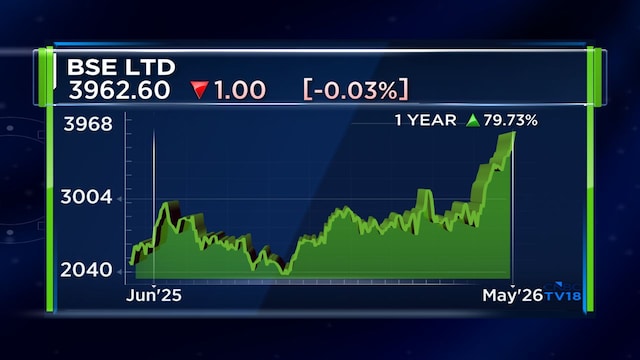
The stock is currently trading at ₹3,961.30 as of 11:21 am on the NSE and has gained 77% over the last year.
In the January–March quarter (Q4FY26), BSE reported operating revenue of ₹1,563.51 crore and a net profit of ₹797.33 crore.
These are edited excerpts from the interview.Q: As you continue to beat expectations, the market is naturally raising expectations further. Fourth quarter revenue growth of 85% year-on-year and profits up nearly 60% to around ₹800 crore. Could you give us a sense of how much of this growth is structural and here to stay, particularly in terms of market share gains?
A: Our metrics continue to remain what they have always been, and we measure success only through those metrics, not just market share in respect of equity derivatives.
We have seen stupendous growth — from 446 members at the beginning of the year to around 587–590 active members participating with us in equity derivatives. FPIs have increased to over 520. Monthly contract volumes have risen nearly five times, index futures volumes have grown three times, and options premium turnover has almost doubled over the last year.
These are the parameters we look at, and we are very proud of this growth. That is where our focus will remain.
Q: Those numbers certainly explain the growth story. But I am coming back to market share because that’s what the market tracks very closely. I believe your premium market share moved from under 27% in quarter three to around 27.5% in quarter four, and then to 34% in April. What has changed for BSE to grow at this pace and gain share?
A: That’s a very good question. What changed was the response from market participants. When we initially introduced this contract, we had to explain the product to people. Subsequently, there was no need to actively promote it — people automatically started looking at Sensex products.
Software vendors came in, market participants started supporting the product, and we received strong support from all corners of the ecosystem. That pushed us to improve technology, enhance capacity, upgrade peripheral systems and strengthen our human resources.
We also engaged with FPIs to make them look at the product more seriously. All of this contributed to the growth we are seeing now. Going forward, our focus is on deepening and broadening participation. We are concentrating on monthly options volumes, more products and strengthening Bankex as another successful product. We are seeing initial success there and want to build on it further. Futures and additional indices with monthly options and futures will be the next phase of growth.
Q: Transaction revenue now contributes around 84% of total revenue, and options alone account for nearly 72%. I am assuming that’s why you want to widen the revenue base going forward and avoid concentration in a single segment?
A: That’s a very valid point. Concentration is never ideal, whether in earnings or in markets. Diversification is important everywhere.
That is also why we did not want all activity concentrated only on expiry days. Earlier, nearly 90% of volumes were concentrated on expiry day, but today expiry-day concentration is below 40% of total weekly volumes.
Similarly, we want more monthly products and greater product variety. Markets should not depend on just one product. Different products cater to different needs and market conditions.
Q: If I may ask directly, what is the ambition in terms of market share on the options side from here?
A: Honestly, our ambition is not defined purely by market share. Our ambition is to have at least 800 FPIs and around 700 brokers actively participating with us.
We also want to significantly expand the client base. Currently, around 3.5 lakh clients trade regularly with us, and that number should grow much higher. Considering India’s demographics, the potential is far larger. That is our ambition.
Q: Let’s talk about longer-dated options. Your share there is still relatively small. That business would require more institutional and hedging-led activity. How do you plan to grow that segment?
A: That’s absolutely correct. Longer-dated options require institutional participation and hedging activity. Some participants who already trade these products elsewhere need to come into BSE as well.
For that to happen, liquidity beyond the current expiry cycle has to improve. Right now, activity is concentrated in the current and next month. We need products trading across the third month, fourth month and ideally up to one year.
We are speaking to market participants who can provide liquidity and support both sides of the market. We are also engaging institutions that focus on longer-term hedging strategies.
Apart from that, we believe the margin structure for longer-term options needs reconsideration. Margins sometimes make longer-term positions expensive. We have submitted our suggestions on what could help shift activity toward longer-term options. We believe regulators will examine these suggestions in due course, which could benefit the broader market as well.
Q: On the futures side, traders often say Index futures trading has slowed because of factors like higher securities transaction tax (STT). Since the STT hike from April 1, have you seen any impact?
A: I will answer that in parts. At this point, it is difficult to isolate the impact of STT because markets are not in a steady state. Global volatility remains very high, so it is difficult to attribute changes to one parameter alone.
Secondly, BSE’s futures base is still relatively small and evolving. This is only a three-year journey for us, and the futures segment has an even shorter history.
Intuitively, I do feel futures activity is somewhat tepid compared to options. There could be multiple reasons — some participants may be creating synthetic futures positions because they are cheaper. But regarding the specific impact of STT, we will need more time to assess it properly.
Q: StAR Mutual Fund grew around 13% quarter-on-quarter. What is the strategy to grow the non-transaction side of the business?
A: I appreciate that question. Today, the total number of unique mutual fund investors in India is still only around six crore. I believe we are celebrating growth from a relatively small base.
The potential is enormous. With India’s population size and a median age of 29, many people are still outside the mutual fund ecosystem. In my opinion, mutual funds are the best entry point into capital markets for first-time investors because professional portfolio managers handle the risk management aspect.
I believe more people will continue joining the ecosystem as financial awareness rises. SEBI is doing a good job, exchanges are contributing, and the industry is promoting safer investing habits.
This is just the beginning. I believe mutual funds, and consequently StAR MF, have a very long growth runway ahead.
For full management commentary, watch the video