1 hour ago
US Congressman Riley Moore has criticised the proposed FCRA amendments, saying they could enable government control of churches and religious charities. The remarks have sharpened a wider debate over the Bill's oversight powers and their impact on foreign-funded institutions.
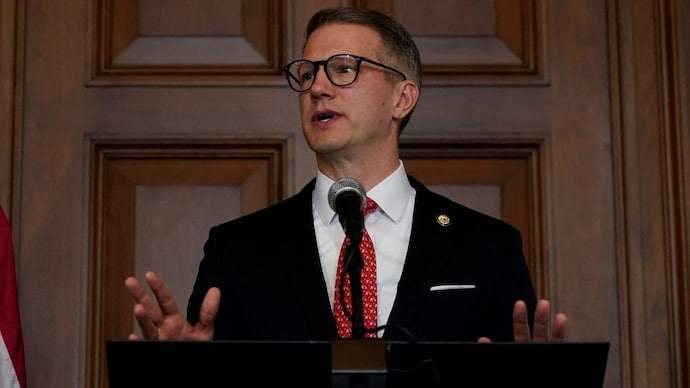
The US Congressman referred to the long history of Christianity in India before raising concerns over the proposed amendments. (File Photo: Reuters)

UPDATED: Aug 5, 2026 01:10 IST
A proposed amendment to the Foreign Contribution (Regulation) Act (FCRA) has come under criticism from US Congressman Riley Moore, who described it as "a clear attack against Christians" and warned it could become a bilateral issue between India and the United States.
Calling the proposed amendments to the FCRA "a clear attack against Christians", he alleged that the legislation could allow the government to take control of churches and religious charities. His remarks come as the Foreign Contribution (Regulation) Amendment Bill, 2026 continues to trigger sharp debate during the ongoing Monsoon Session of Parliament.
US LAWMAKER CRITICISES PROPOSED CHANGES
In a post on X, the US Congressman referred to the long history of Christianity in India before raising concerns over the proposed amendments.
"Christians have been in India since St. Thomas the Apostle travelled to the Malabar Coast just decades after the resurrection of our Lord Jesus Christ," he said.
He then criticised the Bill, saying: "But despite this long Christian history, India's Parliament is considering amending Foreign Contribution Regulation Amendment (FCRA) rules to permit government takeovers of churches and religious charities."
"This is a clear attack against Christians. If this bill proceeds in this way, it would be a point of major concern in our bilateral relationship with India," he added.
WHAT THE FCRA BILL PROPOSES
The proposed legislation seeks to amend the Foreign Contribution (Regulation) Act, 2010, which governs how non-governmental organisations, charitable trusts, educational institutions, religious bodies and associations receive and use foreign donations. Under existing rules, organisations must obtain registration from the Ministry of Home Affairs before accepting foreign contributions. That registration has to be renewed every five years.
According to the background note accompanying the Bill, India had 14,449 active FCRA registrations as of July 15, 2026. Another 22,498 registrations had been cancelled, while 15,212 had expired. Between 2019 and 2022, organisations registered under the Act received foreign contributions worth Rs 55,741 crore.
Among the most significant proposals is the creation of a Designated Authority, appointed by the Central Government, with powers to take over the management of foreign contributions and assets created using those funds if an organisation's FCRA registration is cancelled, surrendered or not renewed.
The Bill also proposes a minimum utilisation threshold for renewal. Organisations that have received or used less than Rs 10 lakh in foreign contributions during the previous two financial years may no longer qualify for renewal.
Additional provisions include tighter restrictions on transferring foreign contributions to other organisations, stricter timelines for receiving and using overseas funds, and expanded disclosure requirements relating to projects, activities, websites and social media accounts.
WHY THE BILL HAS TRIGGERED CONTROVERSY
The proposed powers of the Designated Authority have become the centre of the debate.
Opposition parties, NGOs and several civil society groups argue that the amendments give the Centre sweeping control over organisations dependent on foreign funding. Churches and religious organisations have expressed particular concern that schools, hospitals, welfare institutions and other assets built over decades with foreign donations could come under government control if their registrations lapse or are cancelled.
Those concerns have been especially pronounced in Kerala, where many Christian organisations operate large educational and healthcare institutions that have historically relied on overseas contributions.
The government, however, has defended the proposed amendments as a measure to improve transparency, strengthen oversight and ensure greater accountability in the use of foreign funds.
- Ends
Published By:
Satyam Singh
Published On:
Aug 5, 2026 01:10 IST