2 hours ago
Iran said it used its new Arash-e Kamangir air defence system to bring down a US MQ-9 Reaper drone near the Strait of Hormuz, a claim that has reignited debate over how much of Tehran's air defence network remains operational after repeated Israeli and US strikes.
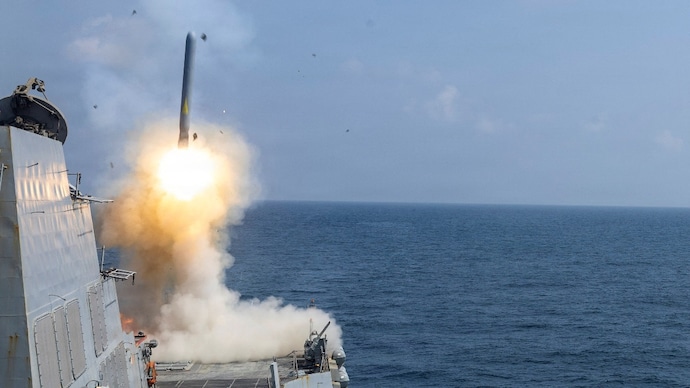
While analysts cautioned that Iran’s claims remain difficult to independently verify, several experts said the broader concept behind the system appeared credible. (Photo: Reuters)

New Delhi,UPDATED: May 29, 2026 18:09 IST
Iran has claimed it used a newly developed air defence system to shoot down a United States MQ-9 Reaper drone, which costs $30 million, near the Strait of Hormuz earlier this week, a move analysts say signals that Tehran still retains the ability to challenge US and Israeli military operations despite months of strikes on its military infrastructure.
Iran’s Fars News Agency reported that the drone was intercepted near Qeshm Island using a locally developed system called Arash-e Kamangir, marking what it described as the weapon’s first combat deployment. There has been no independent verification of the claim.
The reported downing of the drone comes amid escalating tensions between Tehran and Washington despite a fragile ceasefire. US forces are said to have launched fresh strikes on an Iranian military site near Bandar Abbas, while Iran’s Islamic Revolutionary Guard Corps (IRGC) later claimed it targeted an “American airbase” in retaliation.
WHAT IS ARASH-E-KAMANGIR?
According to Iranian media, Arash-e Kamangir is a stealth-detection system capable of intercepting “hostile” reconnaissance drones operating near Iranian airspace and maritime borders.
“This operation, which was carried out using a system with hidden capabilities, is a clear and decisive message from Iran,” Fars quoted unnamed officials as saying.
The name Arash-e Kamangir translates to “Arash the archer”, a legendary figure from Persian mythology celebrated for defending Iran against foreign domination.
According to Iranian folklore, the boundary between Iran and Middle Asia was set by an arrow launched by Arash, after he put his own life in the arrow's launch.
HOW CREDIBLE IS IRAN’S CLAIM?
While analysts cautioned that Iran’s claims remain difficult to independently verify, several experts said the broader concept behind the system appeared credible.
Tehran has increasingly invested in low-cost, mobile and domestically produced air defence systems designed to target drones and aircraft without relying on large fixed radar installations that are easier to destroy.
Al Jazeera quoted Mark Hilborne, senior lecturer at King’s College London’s School of Security Studies, as saying “there was very little independently verified information” about the system, though he added that the reported interception “fit a wider pattern”.
“Iran has become quite self-sufficient in various forms of missile design and, like Ukraine, has been clever at changing the economics of warfare. Cheap, simple systems can hold much more complex systems at risk,” he added.
WHY DOES THE SYSTEM MATTER?
Analysts believe the system may be linked to Iran’s growing arsenal of short-range or loitering surface-to-air missile platforms. The Al Jazeera report also mentioned that Alex Almeida, a security analyst at Horizon Engage, believes that the system likely avoided reliance on traditional radar guidance.
Experts said such systems are harder to detect because they are mobile, cheaper to produce and easier to replace than traditional air defence batteries. Some are designed to remain airborne while waiting for enemy aircraft or drones to appear, making slow-moving surveillance drones like the MQ-9 Reaper particularly vulnerable.
Iran’s larger radar-guided air defence network, including Russian-supplied S-300 systems, is believed to have been heavily degraded by repeated US and Israeli strikes.
However, analysts say the latest interception suggests Tehran still retains enough capability to maintain a “persistent, limited, low-level air threat” that could complicate future military operations.
These systems may not stop a major air campaign, but they can force the US and Israel to rely more heavily on expensive long-range weapons rather than drones.
- Ends
Published By:
Shipra Parashar
Published On:
May 29, 2026 18:09 IST