 1 month ago
Four hundred thousand children in the UK were supported by baby banks in 2025, an 11% increase from the year before, prompting warnings from charities that they “cannot continue to absorb the impact of child poverty on this scale” without government support.
New research from the Baby Bank Alliance, set up by Save the Children UK to represent and advocate for more than 400 baby banks across the country, found that an average of 1,096 children were being supported by each member every day, with some essential items soaring in demand.
About 26% more tubs of baby formula were handed out by baby banks in 2025 compared with the year prior, and there was a steep rise in the number of cots and beds given to families.
A record 4.5 million children are living in poverty across the UK, according to the latest data. Earlier this year, the government abolished the two-child benefit limit, which restricted families to universal credit support for their first two children only.
The damning figures have prompted calls for the government to ensure that lifting the two-child benefit cap is just “the beginning of its actions to tackle child poverty”.
Sophie Livingstone, the chair of the Baby Bank Alliance, said: “It’s pretty damning, isn’t it? Families are needing help for systemic reasons, not because there’s a one-off shock to their lives.”
About 75% of families supported by alliance members point to unsuitable or insecure housing as a pressure they face. Livingstone is also the chief executive of Little Village, a London-based network of baby banks that support a large number of families living in poor and often squalid housing. “We often have families needing us to replace all their children’s clothes because they’ve been rotted by mould,” she said.
Livingstone has seen a rise in demand for cots and beds. “We never have enough beds. It’s really difficult when we come across a family sleeping on the floor in rodent-infested accommodation,” she said. Livingstone also said Little Village “never has enough large nappy sizes”, which she connects to families living in cramped housing, including temporary accommodation. “My assumption is that it’s linked to the fact that it is going to take a child longer to potty train if they’re in that situation,” she said.
She is calling on the government to pull on “some big levers to make life for all families in this country livable”.
“We know families are struggling more than ever with work and housing insecurity, rising energy and food bills, and unaffordable childcare,” she said. “Baby banks are doing everything they can to provide a crucial safety net and stop families from falling through the cracks, but charities alone cannot continue to absorb the impact of child poverty on this scale. It’s time the government took the impact of poverty in children’s early years more seriously.”
At the Little Lighthouse baby bank in Wythenshawe, Manchester, located in a church hall, toddlers are reading books and playing together while parents look on with a cup of tea.
The baby bank provides clothes, books, toys and assorted equipment, much of which is spread out on tables for parents to take – though some items, including nappies, toiletries and baby formula for mothers who are unable to breastfeed, are handed out on a referral basis, particularly since demand for these essentials has increased in recent months.
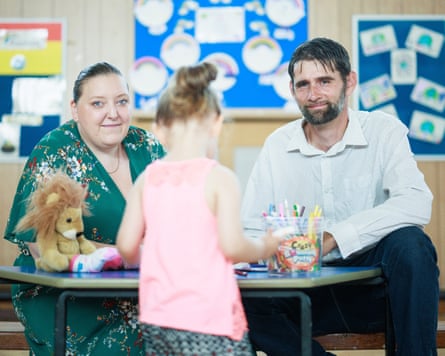
Laura, 39, has been coming to Little Lighthouse for nearly three years. “I intended to breastfeed but I struggled because I wasn’t producing enough milk. The midwife said, ‘You’re going to have to use formula,’” she said. “We struggled in the start because my partner wasn’t working. We used to get milk and baby wipes from here.”
She also came to the baby bank for the social side. Laura was about to have her first child with her partner, Daniel, 46, who is now a self-employed fire technician, when they first visited. “When we found out, we wanted to meet people who were having children at the same time,” she said. Now, the couple both volunteer at the baby bank.
Laura said the costs for “absolutely everything are just skyrocketing”. The couple “would both like another child” but have decided against it. “We wouldn’t want to have another child knowing that we’d struggle financially,” she said.
While the baby bank is “a brilliant thing”, she said “the fact that people have to come because they can’t afford to get things for their children is really sad.”
Outside London and the south-east, north-west England has the highest number of families supported by baby banks in the UK. One of the financial pressures hitting the region is the rising cost of housing. One mother, who did not want to be named, said her rent went up from £795 a month to more than £1,500 in the space of a few years.
The Rev Caroline Hewitt set up the Little Lighthouse baby bank in September 2019. She said “the need has increased” since then, especially for baby formula, which has soared in price in recent years. “We’ve had families who won’t miss their referral, which is new,” she said. “Some families just cannot cope if they do not come to the baby bank.”
Hewitt said the money a family saves by not buying a tub of baby formula, which can cost from about £12 to £20, or a pack of nappies, “might feed the rest of the family for two days”. Families who use the baby bank are usually on low incomes, including some who are in work.
On the day the Guardian visited the baby bank, votes were being cast nearby in the Makerfield byelection, where Andy Burnham ultimately romped to victory. Hewitt is hopeful about Burnham’s approach to the issue, saying “he’s shown quite considerable interest in the baby bank network across Greater Manchester”.
Livingstone said baby banks are an “incredible community effort” but she would love to see a society where they are “not solely run in the context of families being in crisis”.