2 hours ago
The Sikh politicians and community leaders are in a mode a fight to defend the right to carry kirpan in the United Kingdom. The Sikh community is facing mounting pressure as there are calls to ban kirpan in the country by activists after the stabbing of British-Polish teenager Henry Nowak by Vickrum Digwa.
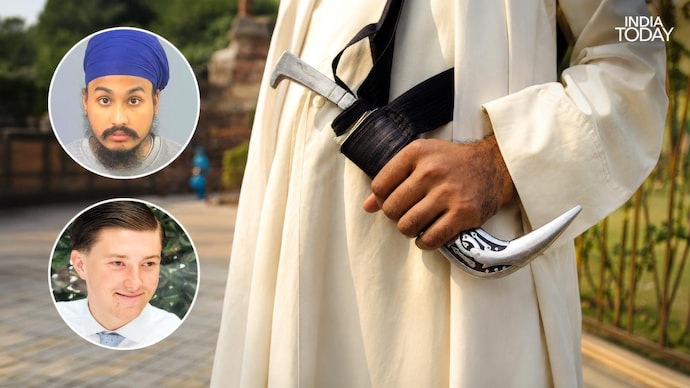
The Sikh community in the UK argues that Vickrum Digwa did not kill Henry Nowak with a kirpan. (Image: File/Vipul Kumar)
The Sikh community in the United Kingdom is facing growing hostility and scrutiny over the carrying of kirpans, one of the five articles of the faith of Sikhism, following the stabbing of British-Polish teenager Henry Nowak by 23-year-old Vickrum Digwa in December 2025. The debate intensified as Digwa, a Sikh youth, was sentenced to life in jail in May. Sikh leaders, politicians, and community organisations in the UK insist that much of the public anger is being directed at the wrong target and are fighting a battle to defend their religious rights.
The central point of contention is the kirpan, the ceremonial blade carried by initiated Sikhs as one of the Five Ks, or Five Kakars, the articles of faith. While some activists in the country have demanded a ban on kirpans following Nowak's murder, Sikh groups argue that the teenager was not killed with a ceremonial kirpan but with a separate, larger dagger that Digwa was carrying.
The distinction has become the focus of a wider debate over religious freedom, public safety, knife crime, and the legal exemptions granted to Sikhs under British law.
THE RISING BACKLASH AGAINST SIKHS IN THE UNITED KINGDOM
In the days following Digwa's conviction in May, Sikh organisations reported a sharp rise in hostility towards members of the community across the UK. Community leaders say at least 15 Sikhs have been confronted in public by groups demanding to know whether they were carrying a kirpan.
"Many Sikhs have been approached by groups of individuals attempting to provoke tensions by asking about kirpans," Amandeep Singh, an educator in the UK was quoted by The Guardian as saying.
He also warned that the atmosphere had become increasingly hostile and reminded people that Sikhs had previously been victims of racist attacks, including incidents in which elderly Sikh men had their turbans forcibly removed.
"The fact that I can't legally carry pepper spray but Sikhs can legally carry this is absurd," posted Essex-based commentator Sophie Corcoran on X with an image of a kirpan.
In a joint statement, Sikh organisations condemned the murder and described it as "a moment of madness" by one individual. They stressed that the actions of a single person should not be used to judge an entire community.
Kuldeep Singh Deol, former president of Guru Nanak Gurdwara Smethwick, told The Guardian that the Sikh community was deeply saddened by Nowak's death and expressed sympathy for the victim's family. He added that the release of police body-camera footage had made the tragedy even more painful for many people to witness.
BRITISH SIKH POLITICIANS DEFEND RIGHT TO RELIGIOUS PRACTICE
Among those speaking out was UK Labour Party MP Tanmanjeet Singh Dhesi, who raised the issue in the House of Commons (UK Parliament) on June 3.
Dhesi paid tribute to Henry Nowak and offered condolences to his family. At the same time, he criticised "attempts to use the tragedy to target the wider Sikh community and to call for a ban on the kirpan".
Dhesi, an Indian-origin British politician, reminded the UK Parliament of the historic contributions of Sikh soldiers who fought alongside British forces during both World Wars and argued that Sikhs had been loyal contributors to British society for generations.
The Labour MP's intervention reflected growing concern among Sikh representatives that a criminal act committed by an individual is being used to question long-standing religious rights enjoyed by law-abiding members of the community.
Labour Party MP Sarah Coombes also defended the right of Sikhs to carry the kirpan.
"Both the Tories and Reform are now saying the kirpan should be banned. This is totally wrong. The kirpan is a key article of the Sikh faith. An entire community cannot be tarred by the horrendous actions of one person," Coombes said.
BRITISH HOME SECRETARY REJECTS CALLS FOR KIRPAN BAN
The debate intensified after Pakistan-Occupied Kashmir-origin Home Secretary Shabana Mahmood defended the legal right of practising Sikhs to carry ceremonial kirpans.
Mahmood argued that existing laws in the UK already provide sufficient safeguards against misuse. Under current legislation, Sikhs are allowed to carry a kirpan for religious reasons, but using any blade in an act of violence remains a criminal offence.
The Home Secretary's comments came as public pressure mounted from some quarters to remove the religious exemption following Henry Nowak's killing.
Dabinderjit Singh, chief executive of political engagement at the Sikh Federation, has written to Shabana Mahmood, Deputy Prime Minister David Lammy, and Attorney General Richard Hermer. Singh argued that misinformation surrounding the murder weapon had caused significant damage to the Sikh community and fuelled hostility against Sikhs.
IS IT LEGAL TO CARRY A KIRPAN UNDER UK LAW?
The kirpan is one of the Five Ks, which are considered the five articles of faith adopted by initiated members of the Khalsa, the community of Sikhs. The Five Ks are Kesh (uncut hair), Kangha (wooden comb), Kara (steel bracelet), Kachera (special undergarment), and Kirpan (ceremonial blade).
The word kirpan is derived from two Punjabi words, kirpa, meaning compassion, and aan, meaning honour or dignity. In the Sikh teachings, the kirpan symbolises a duty to defend the weak, oppose injustice, and protect the vulnerable.
Under Section 139 of the UK Criminal Justice Act 1988, carrying a knife or bladed article in public is generally prohibited. However, the law provides a defence for individuals who possess such an item for religious reasons. This exemption allows practising Sikhs to carry a kirpan as part of their faith.
The law draws a clear distinction between carrying and using a blade. Possessing a kirpan for religious purposes is lawful, but using any blade to threaten, injure or kill another person remains a serious criminal offence.
Supporters of the exemption argue that the law has functioned effectively for decades and that isolated incidents should not undermine religious freedoms enjoyed by thousands of peaceful Sikh citizens.
The UK also recognises other cultural and religious exceptions involving bladed items, including the carrying of the sgian dubh as part of traditional Scottish Highland dress.
The Henry Nowak case has reopened a difficult debate. For Britain, the challenge remains balancing religious liberty with concerns about knife crime and public safety. Sikh politicians, community leaders and organisations are united in defending the right to wear the kirpan and maintain the Five Ks. They argue that Henry Nowak's tragic death should be seen as the act of an individual offender, not as a reason to strip a centuries-old religious minority of protections that have long been recognised under British law.
- Ends
Published By:
Avinash Kateel
Published On:
Jun 9, 2026 16:33 IST